Chapter Nine
The Door at 11:17
We went down at ten past nine, by the light of James's lamp.
He had insisted on bringing it. It was an old railwayman's lantern with a hinged glass and a brass handle, and he carried it in his left hand and the ledger in his right, held against his chest, as a man carries a child through a flood. He had not been underground since he was a young man, he said, not under Veyra, not once in thirty years of cataloguing its secrets, and he went down the iron ladder of the pump house slowly, rung by rung, murmuring to himself. I went first. At the bottom I held up my hands to steady him, and he set his boots on the stone with a long relieved sigh, and stood for a moment with the lantern lifted, looking down the tunnel.
"Well," said James. "There it is."
It was exactly as I had left it. The brick vault, the rusted rails, the white sparkle of damp. The long procession of clocks went away into the dark in two rows, one on each wall, a mile of small blind faces. They said what they had said before.
We walked.
I had expected the sound. I had braced for it. For the first hundred yards, I held myself rigid, waiting for the soft, patient, answering footstep behind us. It did not come. There was only our own tread, and the slow drip, and the rasp of James's breath. At the vault, the great domed chamber with the tally board, I stopped and swung the torch across the floor.
The footprints were gone.
The dust was smooth. Not smooth as if it had been swept: smooth as if it had never been walked on. It lay across the stone in a fine grey sheet, undisturbed from wall to wall. I stood and looked at it for some time.
"It's cleaned up," said James quietly. "It does that, I think. It doesn't like to be seen to have been here."
I went to the board.
There were a hundred and twelve brass tags in their rows, as before. There was the small, bright, polished one at the bottom. A. CARTER. And beside it, on the hook that had been empty three days ago, with its screw newly gleaming and the wood around it freshly scored, another.
It was small. It was thin. It had been stamped, by the same crooked hand, in the same capitals.
D. CARTER.
I put out my finger and touched it. It was cold. It turned a little on its hook, and swung back, and I felt the whole of the great vault lean in around me, listening.
"It's ready for you," said James.
"Yes."
"It's been ready a long time." He lifted the lantern. The light trembled on the brick. "Daniel. If you want to go back, you can. I'll take you. I'll carry you, if need be. There's no shame."
I took the key out of my pocket. The red thread had frayed to a few brown strands. It lay across my palm like a small dead thing.
"I turned this," I said. "Twice. I'm sure of it now. Once when I was sixteen, and once when I was twenty. I don't know which was the crime." I closed my fingers. "I have to find out."
The clocks began to tick at sixteen minutes past eleven.
I had been watching the vault wall, the long lattice of brass hooks and white faces, for what seemed a very long time, and I did not at first realise what I was hearing. It was a very faint sound. A single dry tick, from far down the tunnel behind us. Then another, closer. Then a third, from the wall to my left, small and neat and precise.
I turned the torch on them. Nothing moved. The hands on every face were as they had always been, laid together at the three and the eleven, like a pair of closed lips.
But they were ticking.
They were ticking all together. They had begun, one by one, like a congregation drawing breath, and now the vault was full of it: a rising, rustling, whispering, pattering tide of ticking, ten thousand small mechanical hearts, beating in the dark. It ran down the tunnel and back. It ran through the stone under our feet. It grew, and quickened, and the whole chamber seemed to shiver like the skin of a drum.
"Oh, no," said James. "Oh, Lord."
"What is it?"
"They're counting."
"Counting what?"
"I think they're counting down."
The ticking crescendoed. I put my hands over my ears. It was unbearable. It was the sound of a vast and indifferent machine, and I knew, with a certainty beyond argument, that at the end of it something would be asked of me.
Then it stopped.
All of it, all at once. A single catch, as though a hand had come down over every pendulum in the city. And in the silence, so thick that I could hear the blood moving in my own ears, a voice, behind me, courteous and low, said:
"Ah. Right on time."
I did not need to turn. I knew, as one knows a pain.
He stood at the mouth of the vault, a little way back in the dark, in his pale grey suit, with his hands clasped before him and his silver head slightly bowed. He carried no lamp. He seemed to need none. The soft light that clung to him made his face look very pale, and very tired, and, in some way I could not define, glad.
"Mr. Miller," said James Wilson.
"James." David Miller inclined his head. "It's been a very long time since you've left your archive. I'm touched."
"I've brought a ledger."
"I imagine you have." He turned his gentle eyes to me. "Daniel. I told you I would see you at eleven-seventeen. I do try to be punctual."
"Why are you here?"
"Because there is a photograph in my drawer," said David Miller, "and I should like to see whether it is correct."
I stared at him.
"I did not think it would be," he went on. "Not at first. I have, I admit, been disappointed in these things before. But I looked at it again this morning, and the hand was, forgive me, rather clear." He glanced at the wall. "You see, Daniel, I have never been through that door."
"Which door?"
He pointed.
I had been looking at the board. I had not looked at the wall beside it. It was a blank section of brick, perhaps twelve feet high, between the tally hooks and the chained gate. I raised the torch.
It was not blank.
In the middle of the brick, where there had been nothing, there was a door.
It was enormous. It rose from the floor to the roof of the vault, a single slab of black iron, riveted, banded with bolts the size of my fist. It had no handle. It had no lock. It had, in the centre, at the height of a man's chest, a small round hollow, the size of a coin, and in the hollow, a keyhole.
It was an ordinary keyhole. The sort one finds in the door of a bedroom.
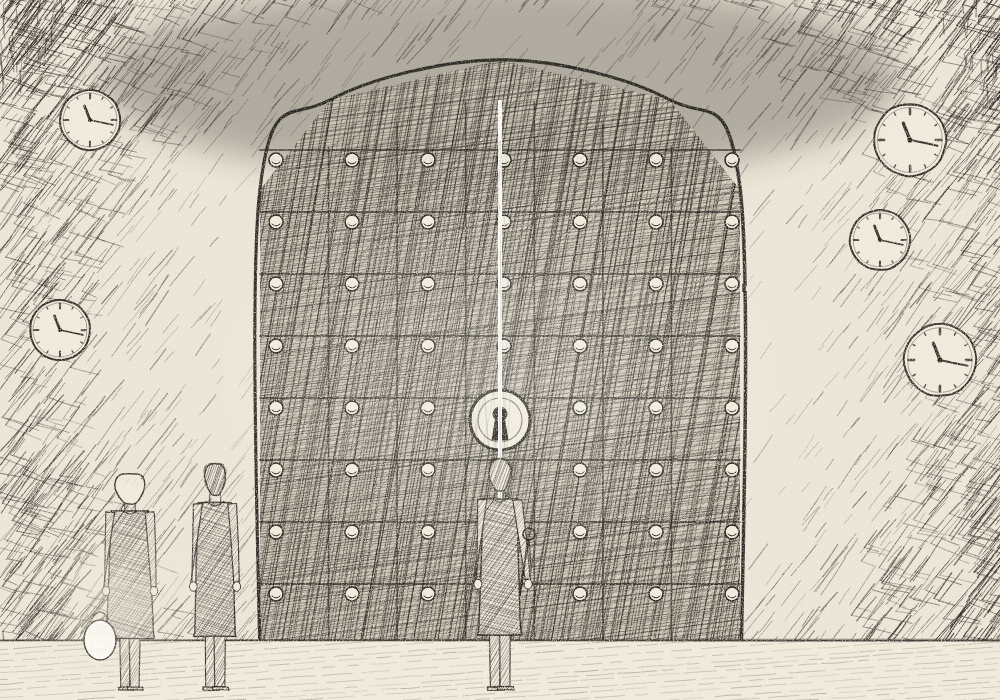
"It wasn't here," said James, in a shaken voice.
"It is always here," said David. "It is only that no one is able to see it. It requires..." He hesitated. "A certain condition. One has to have been forgotten, thoroughly, by everyone who ever loved one. Otherwise the eye slides off." He smiled at me, with great gentleness. "You have reached it. In the last four days, you have lost your landlord and your friend and your employer and your neighbours. Almost everyone. There are only two of us left, I believe, who can still say your name."
"You and James."
"Yes." He looked at James. "I wonder which of us you trust."
I put the key in the lock.
It was a little loose. I turned it. I had a flash, very clear, very brief, of a small brown door on a dark landing, and a boy's wet hands, and a bolt going home. Then it caught, and turned, and I heard from inside the iron a long slow ponderous grinding, like a great wheel being coaxed into motion after a hundred years.
The door swung inward.
It opened without effort, on silent hinges. A pale, even, shadowless light came out of it, like the light in a room with the blinds drawn on a winter afternoon. There was a smell. Paper. Dust. Wool. Hair-oil and wet leaves and hot tin. A hundred thousand small scents, each one sharp and familiar and impossible to name, so that I stood on the threshold and felt, in rapid succession, nine years old, and twelve, and sixteen.
I looked back.
James had put down his lantern. His hand was over his mouth. David Miller stood very straight, with his eyes shut and his lips moving slightly, as one who prays, or who counts. Neither of them moved toward the door.
"I can't," said James. His voice shook. "I'm sorry, Daniel. I'd come if I could. I can feel it. It's like a hand against my chest."
"It is only for the forgotten," said David, without opening his eyes. "I am sorry. I have waited thirty years for this." His lashes were wet. "Go on, my dear boy. I shall be here."
I went in.
I have tried to describe the place to myself every night since, and I have not succeeded. I will tell you only what I saw.
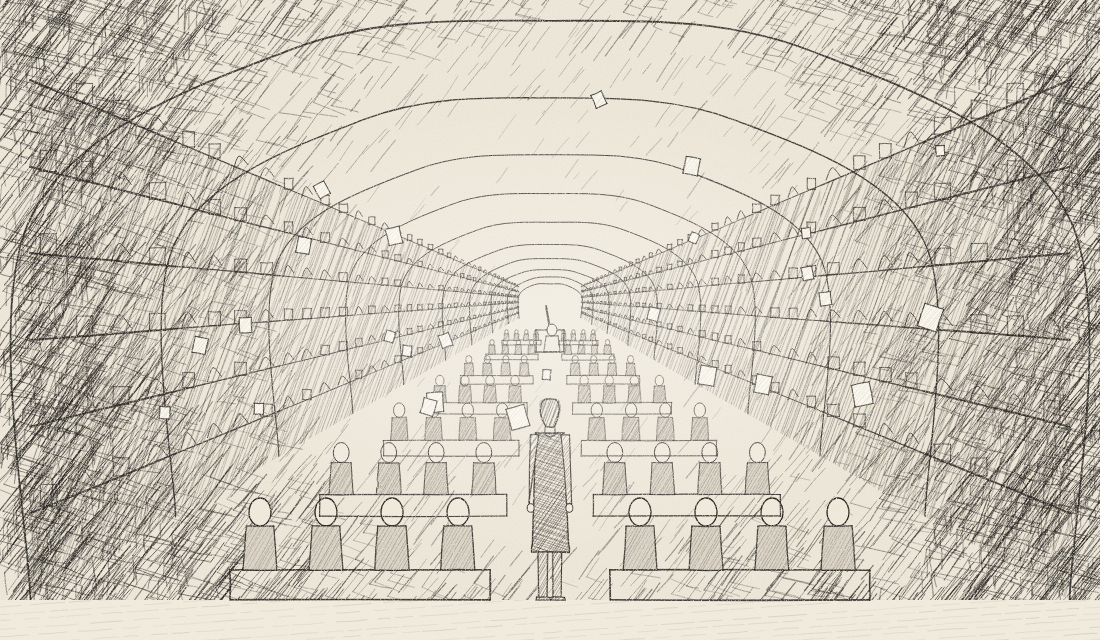
It was a hall. A hall of such size that I could not make out its ceiling or its far wall, although the light, that dim soft grey light, seemed to come from everywhere at once. It was lined with shelves. Not shelves of wood. Shelves of something pale and smooth, like bone, that curved away on either side into an immense perspective, row upon row, tier upon tier, rising and falling and winding like the streets in Anna's drawing.
And on every shelf there lay, in perfect order, everything that Veyra had forgotten.
Photographs. I saw them first. Tens of thousands of them, in neat stacks, in albums, in shoe-boxes, in frames. Wedding pictures. School groups. Babies in christening gowns. Every face was clear. Every face was smiling. They lay there under a dustless glow, the whole bright history of a city, with the names of the subjects pencilled on the backs in hands I knew I would never read.
Beyond them lay objects. Umbrellas, a thousand of them, furled, with their wooden handles pointing up. Spectacles on a long string. A rocking horse. A child's shoe. Wedding rings in a heap, like grain. Letters tied in ribbon. A violin, in an open case, lying on a cushion of velvet, and beside it, a bow with its hairs loosened.
And under the objects, in glass jars, in tin boxes, in little glazed urns, were the voices.
I do not know how else to put it. They were not visible. But I heard them. A hushed, rippling, murmuring susurrus, like a library full of people reading aloud, rose from every shelf, and as I passed, they turned toward me, as plants turn toward the light. A woman, laughing. A man, singing off-key. A child, counting. A whole street of voices, saying good morning, good morning, good morning, in the dozen accents of a city that had once been busy.
I did not stop. I do not think I could have.
Further in, there were people.
They sat on benches. Long low benches of pale wood, in rows, in the grey light, like the benches of a station waiting-room at the end of a very long night. There were hundreds of them. They were of all ages, men in caps and women in head-scarves and children in school jerseys, a girl in a pinafore with a hoop, an old man with a stick. They did not speak. They sat with their hands on their knees and their faces lifted, slightly, toward the door. Each had the fixed, patient, listening look of someone who has been told that they will be sent for.
I saw the girl with the violin case. She was on the third bench from the end, in the dress she had worn that morning, on the pavement outside the school. She was sitting very straight. Her face was wet. She held her hands in her lap and did not seem to see me. I put my hand out, and my fingers passed through the edge of her sleeve, and it was warm. It was a very warm sleeve.
I was going somewhere, said her lips, silently.
I turned away. I could not look at her.
I walked on, through the shelves and the benches and the whispering, past a tall clock that said seventeen minutes past eleven, past a dressmaker's dummy wearing a bridal veil, past a pyramid of hats. And at the end of a long aisle, where the light seemed to gather, under a high round arch, I saw a small figure standing quite still with her back to me.
She was wearing a yellow cardigan.
I stopped.
I stood in the middle of the aisle and could not go on. I could hear, at an infinite distance, my own heart. I could see the back of her neck, and the short dark hair that ran uphill, and the one thin bony shoulder, a little higher than the other. She was holding something in her hands, and she was looking down at it. She did not turn.
"Anna," I said.
My voice cracked. It came out much too small. She did not move.
"Anna. It's me."
"I know," she said.
She turned.
I do not know how to tell you what it was. I had been ready for the face. I had held it in my head for ten years, in a bright dim circle, like a coin in a pocket. I had seen it, an hour ago, in a drawer, laughing. I thought I knew what I would feel. But I was not ready for the sheer plainness of her, for the small tilt of the head, the tiredness in the eyes, the weight of the thin arms in the yellow sleeves. She was twelve years old. She was exactly twelve. She looked exactly as she had looked when she stood in the kitchen doorway with her face wet and said, Daniel, it's Dad.
And she was looking at me with a kind of shy and appalled joy.
"You came," said Anna.
"Of course I came."
"I didn't think you would." She took a step. Her bare feet made no sound on the pale floor. "I told you not to. I said, don't come, and you came anyway. Dan. You always do that."
I could not speak. I crossed the space between us in three strides and I dropped to my knees on the cold floor and put my arms round her. She was so small. She was thinner than I remembered. She smelled of oranges and pencil shavings and, very faintly, of something older, something mineral and sweet, like the inside of a church. She put her face in my neck. I felt her breath on my skin.
It was warm.
"I'm sorry," I said, into her hair. "I'm so sorry. I'm so sorry. I don't know what I did. They told me I left you here. They told me you were gone. I've been trying to..."
"You didn't leave me here, Daniel."
I stopped.
She drew back. She held my face between her two small cold hands, and looked at me. In the pale light, the scar through her eyebrow was a thin white line. Her eyes were very steady and very dark.
"You didn't leave me here," said Anna. "You let me out."
The whispering in the hall had stopped.
I do not know when. I had not noticed it go. But every voice in every jar had fallen silent, and in the vast, grey, dustless hush, I could hear her breathing.
"I don't understand," I said.
"I know. They took it." She smiled, a little crookedly. "I'll tell you. It's a bit long. Sit."
I sat. She sat beside me on the floor, with her knees drawn up, and her small hands clasped around them, and the thing she had been holding lay in her lap. It was the blue marble's twin. A glass ball, with a white swirl.
"It took me that night," said Anna.
"The first night."
"Yes. When you locked the door." She did not say it with reproach. "I wasn't angry. I want you to know that. You were only sixteen. You were so frightened that you were being sick. I could hear you, on the landing." She rubbed her nose. "I knew you were trying to keep me. And I was so scared, Dan. And I thought, if I just say it. If I just say it back."
"Say what?"
"Yes, Dad."
I closed my eyes.
"It wasn't him," said Anna. "I know that now. It's never anyone. It only sounds like whoever you miss. It only wants to be asked in." Her voice shook slightly. "I said it through the keyhole. And the room went out. All of it. The window, the starfish, the bed. It was just dark. And a very long way off, down at the bottom of a long, long stair, there were people, calling my name."
"And me?"
"You were upstairs. On the landing. I could see you, small, like through the wrong end of a telescope. You were crying." She pressed her cheek against her knees. "I thought, he'll come. And you didn't. You stayed."
"I thought you were gone."
"You were right." She looked at me sideways. "Dan. I was gone for three days. I don't remember most of it. I remember that it was very kind. It was so kind. It showed me everything it kept." She gestured vaguely round the great hall. "It said I could stay. It said I'd be quite safe, and that it would remember me for ever. And it's so lonely, Dan. You can't think. It's the loneliest thing there is. It doesn't want to hurt anyone. It only wants to be told."
"Told what?"
"That it's not forgotten." She smiled sadly. "That's what it is. That's all it ever was. It's every person this city ever stopped thinking about, all together, in one place, and it's so hungry to be remembered. It'll say anything. It'll sound like anyone." Her hands tightened on her knees. "And then, on the third night, it let me go. I don't know why. I think I asked."
"And you came back to the door."
"I came to the door. And Mum let me in."
My throat was tight. "And I don't remember."
"No. They took it. But you were there." She touched my wrist. "You were there for four years. In the room. You brought me books. You taught me chess. You came every night at eleven and sat on the end of the bed, and told me about the day. I drew you. Every year, when you got older." Her eyes shone. "You were the best brother in the world."
I could not speak.
"But it was still in me," said Anna. "Do you see? I'd come back, but it had come with me. A little. Like a seed in a coat. And every night, at seventeen minutes past eleven, I would hear them. All the people, from underneath, calling. And I'd feel myself say things." She swallowed. "I was talking to people in the street, Dan. Through the walls. I didn't want to. It was using my mouth. The more I was in the house, the louder it got, and the more of them went. The ones who answered. I counted. Forty-one. It was forty-one, in the end. Because of me."
"Forty-one," I said. It was the length of the call.
"I begged you to let me go back. For two years. You kept saying, not yet. You'd found a way to keep it quiet, a kind of, of lullaby, I don't know. But it wasn't working. And one night, the night before my sixteenth birthday, which I never had, because I stayed twelve, I asked you for the key." Her face crumpled slightly. "I'd given it to you years before. To keep. So I couldn't change my mind."
"The key to the box-room door."
"It goes down," said Anna. "Behind the wall. The old gallery. It's the bit of the Kessler tunnels that runs under Marrow Lane. It's how I got in and out. Mum had it bricked, but she left the door." She wiped her eyes with the back of her hand. "You came with the key. You were twenty. You were crying. You said, I can't, Annie, I can't, I won't know where you are. And I said, I'll tell you. I'll wait. Every time you say my name, it'll be me, and not it. I said that. I promised."
"And I turned it."
"You turned it." She smiled, through tears. "You held my hand all the way down. And at the bottom, you let go."
I do not know how long we sat there. The silence in the hall went on. A long way off, on a bench, a child coughed.
"That's it," said Anna. "That's all. You didn't leave me. You let me out of the house. You let me stop being its mouth. And it was very quiet, after. For six years, I think. The vanishings stopped. The Department was so pleased." She laughed, a small cracked laugh. "And then you remembered me. You said my name on the telephone. And it all began again."
"I didn't. I mean, I did. I don't understand. You called me. On the line."
Her smile faded.
"Dan," said Anna, "I didn't call you."
The light in the hall seemed to change.
I do not mean that it dimmed. It simply, quietly, altered, like a face when a thought crosses it. I became aware that the hum of the voices had stopped. That there was no sound at all. That the people on the benches, hundreds of them, had turned their heads, and were looking, with their patient fixed faces, at the two of us.
"I didn't call you," said Anna again. "I haven't a telephone. There isn't one here." She looked at me. Her eyes were very dark. "I think it did. I think it made the line. It's been trying to find you for years. It only needed someone to remember."
"You're sure."
"Yes."
"Anna." I took her hands. They were small and cold and dry. "Look at me. I need to ask you something. And I need you to tell me the truth."
"I always do."
"Are you her?"
She did not move.
It was a very long silence. I saw her face, so close to mine, the tired young eyes, the white scar, the crooked fringe. I saw the quiet gentleness of it. I saw the little pulse that beat in the hollow of her throat. I thought of a voice through a keyhole, saying thank you, in a coat that had been pressed.
She may not be only Anna.
"I think so," said Anna.
"You think."
"I was." She spoke very low. "I'm almost sure. I remember being. I remember all of it, the orange peel, the marble, your hand. I remember the smell of Mum's coat." She looked at her fingers. "But it's been so long, Dan. And it was so kind. And sometimes, when I sit very still, I can't tell where it stops. I can't tell which of us is remembering."
"That's not an answer."
"No." She gave me a small, helpless, crooked smile. "It's the only one I've got."
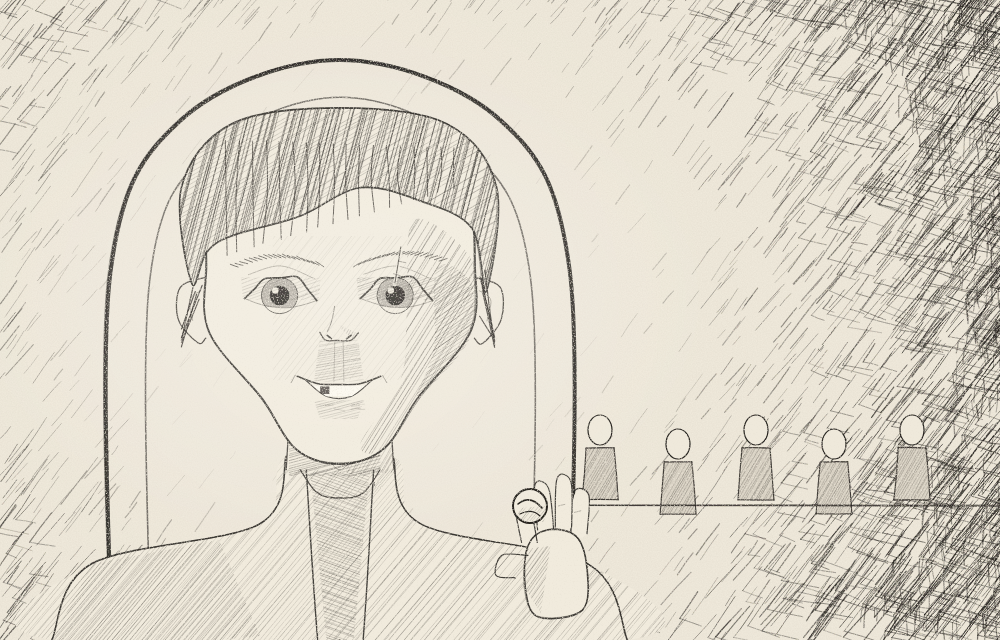
She smiled. And for one instant, in the pale light, as her lips drew back, I saw the gap in her teeth where a molar had been coming in. It was beautiful. It was exactly as I remembered.
It was on the right.
It had always been on the left.
I looked at it, and I looked, and she went on smiling, and when I blinked, it was on the left again, and I could not have sworn, in any court in the world, that I had seen it move.