Chapter Seven
The Night of the First Siren
Michael gave me his sofa and a blanket that smelled of the laundrette, and at nine o'clock he turned off the lamp and said, with his back to me, "If you hear anything, don't say. Just lie still."
"Why?"
"Because I'd rather not know."
He slept, or pretended to. I sat up. The window ran with steam from the machines below, and through it the street was a smear of orange, and I sat on the sofa with the blanket round my shoulders and the notebook on my knee and wrote down everything I knew about the night Anna went. I did it in the way I had always meant to do it, and never had, in columns: what I remember, what I am sure of, what I was told.
It was a very short list.
The night was in November. A Thursday. It had been raining.
I was sixteen. Anna was twelve. Mum was at the Department, working late.
It was the night of the first siren.
I stopped there, with the pencil hovering. I had not written that on purpose. It had simply arrived, as the first words of a sentence do when you are speaking in your sleep. I looked at it. I remembered: they had tried a siren, once. It was in the news. The city council had announced it in the autumn, a new municipal warning system, to be tested in the district for a single night. A great iron horn on the roof of the town hall that would sound at the quarter past eleven, as a courtesy, for the safety of residents. It had been the only time in the history of Veyra that anyone had tried to add a noise to the night.
It had never been tried again.
Why not? I wrote.
I looked at the question. I did not know. And then, as a lamp comes up on a stage in the second after the light is switched, I did.
I was in the kitchen at Marrow Lane.
That was the first thing. I was sixteen, and I was standing at the kitchen table with my homework spread out in front of me, a sheet of algebra with a ring on it where I had set down my cup. The clock above the stove said ten past eleven. The rain was heavy on the window. I remember the smell of toast, and the warm yellow cone of the lamp, and the particular sensation of being alone in a house that I was in charge of.
Mum was out. She had said, Keep the door locked. Don't go out. You know why. I knew why. She had held my wrists at the table when I was nine, and I had promised, and I had kept it, every night of my life, the way you keep the rule not to put your hand in the fire.
Anna was upstairs. I could hear her moving about. She was supposed to be asleep. She had a nightlight shaped like a starfish, and she would not go to bed without it, and she was twelve, and embarrassed about it, and I had been told never to tease her. I did not tease her. I loved her very much.
I heard her come out of her room.
She came down the stairs quickly in her bare feet, and she was crying.
She stood in the kitchen doorway in her pyjamas and her yellow cardigan, with her hair standing up on one side and her face wet, and she said, "Daniel. Daniel, it's Dad."
I remember that I did not move.
"He's outside. He's calling me. He wants me to come." She wiped her nose. "He sounds so tired. He says he's lost his keys."
Our father had died when she was four. A fall, at a building site, from a scaffold. I barely remembered his face. But I remembered his voice, deep and a little hoarse, and the way he said Annie, with the stress on the first syllable, as though it were a word he had made up. I had not heard it in twelve years.
I heard it then.
It came through the kitchen window from the dark garden. It was not loud. It was patient, and kind, and slightly puzzled, a man standing on his own front step in the rain and wondering why the door was shut.
Annie? Annie, love, it's Dad. I've lost my keys.
I remember that it was a quarter past eleven.
I remember it because I looked at the clock. I remember that I had been told the rule, and that I thought of it, and that for one extraordinary instant I thought, it's not true. It can't be. I thought that my mother had been mistaken, or lying, or ill. I thought that if our father were alive, and standing on the step in the rain, then everything I had been taught was wrong, and I might simply open the door.
And Anna said, "Please, Dan."
That is the thing I remember most. Not the voice outside. Hers. She said please in the way she had said it when she was four, and had wanted me to carry her on my back, and I had said I was too tired. She said it with her whole face. She said it as though the whole of her small life depended on my reply.
I took her hand.
It was cold. It was thin. I held it in both of mine.
"Listen," I said. "Anna, that isn't Dad."
"It is."
"It's not. Dad's dead. You know that. It's something else."
"It sounds like him."
"I know it does. That's why it's dangerous." I held her hand tighter. "You have to promise me you won't answer. Mum said. If you hear someone you love, from outside, you don't answer. You don't go to the door. Promise."
She looked at me.
And in that moment, I remember it as clearly as anything in my life, the siren began.
It started low. A deep, flat, mechanical groan, from somewhere far off, over the roofs. It rose. It rose steadily, as though someone were drawing a bow across the string of the whole city, from a growl to a howl to a shriek, higher and higher, until the glass in the kitchen window buzzed in its frame and the cups on the shelf began to rattle against one another. It was the loudest sound I have ever heard. It filled every inch of the house. I put my hands over my ears, and Anna screamed, and I could not hear her.
It went on and on.
And under it, in the roaring, in the shaking, in the crushing wall of sound, I heard our father's voice, quite calm, quite clear, saying her name.
Annie.
Annie.
Annie, love.
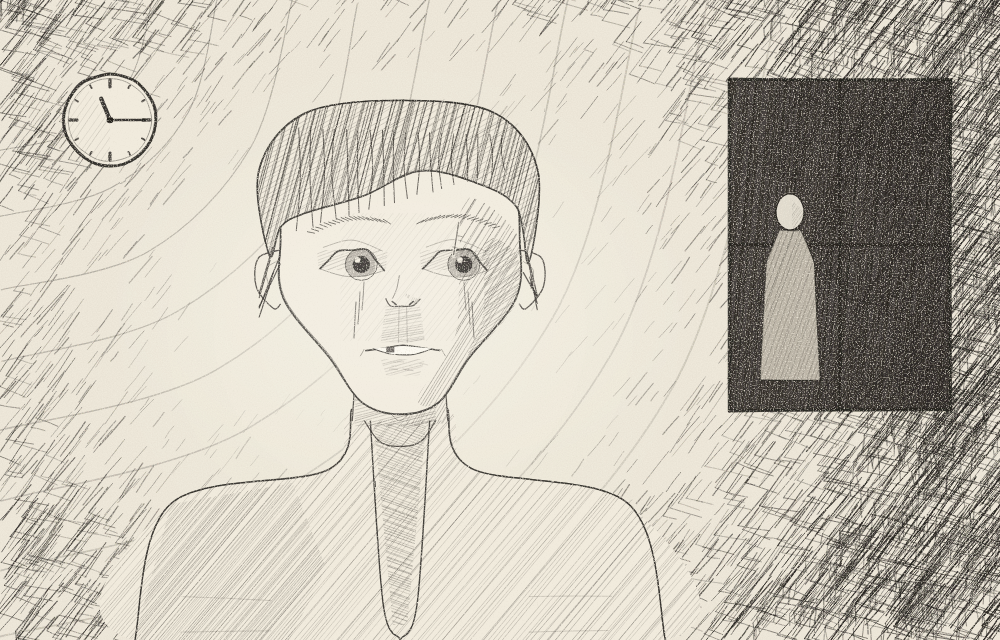
This is where it begins to come apart.
I have tried to tell this part three times to Michael, and once, in a hospital bed, to a doctor with a kind face. Each time it comes out differently. I will give you the versions. I do not ask you to choose.
In the first, I stood in the kitchen and held Anna's hand, and I dragged her to the stairs, and up them, to her room. I put her in. I shut the door. I had never done such a thing. I put my back against it, and she hammered on the inside with both fists, shrieking my name, and the siren howled, and the voice outside the window said Annie, Annie, Annie, and I held the door shut with my whole weight, and I heard her stop.
In the second, I did not take her upstairs at all. I stood in the kitchen with her hand in mine, and she looked at me, with that look, and I let go. I walked to the front door. I opened it. A wet draught came in, with the smell of rain and earth, and I stood aside, and she went past me, quite slowly, in her bare feet, and out down the path.
In the third, it was I who went out. I ran through the garden in my socks, in the dark, in the roaring, and I found her at the gate with her hand on the latch, and I picked her up bodily and carried her back. She was lighter than I expected. She kicked and bit. When I put her down in the hall, she was not Anna. She had her face and her cardigan and her small bony hands. But she was looking at me with an expression that I had never seen on her. It was calm. It was mild. It was interested.
In the fourth, I did not leave the kitchen. I stood by the table with my fingers in my ears, and I never saw her go. I only felt, in the stillness after the siren stopped, that the house had changed. As a room changes when someone has left it.
I have a fifth version. It is the one that frightens me.
In the fifth, I was in bed. I was lying in the dark, in my own room at the back of the house, with the covers pulled up to my chin. I heard the siren go over, and I heard my sister scream, and I did not get up. I lay there with my eyes shut. I told myself that someone else would come. I told myself that I was only sixteen.
I know that cannot be true. I have a memory of her hand.
But I have a memory, too, of the exact texture of the pillowcase.
It was ten to eleven by the clock on Michael's mantelpiece.
I had written all of it down. The notebook lay open on my knee, and the page was a mess of crossings-out, five paragraphs, each contradicting the last. I read them over. They did not agree. They did not even agree about the weather.
Someone has altered my memory, I wrote, at the bottom, and underlined it. And then, below, after a very long time: Or I have.
I put down the pencil. I did not like the second sentence. I looked at it for a long time, and I did not cross it out.
In the pocket of my coat, on the back of the chair, I could feel the two small envelopes. The button. The marble. I took them out and laid them on the blanket, and opened the second, and the blue glass ball rolled into my palm and lay there, cold, with the white swirl turning in its depths.
Something fell out after it.
It was very small. It had been at the bottom of the envelope, lying flat under the marble, and I had not seen it in the dark of the tunnel nor in the grey light of the morning. It made no sound. It landed on the blanket and lay there, glinting, a thin short thing of tarnished brass, with a loop of faded red thread through the bow.
A key.
An ordinary little door key. The kind that fits an interior lock: a cupboard, a cabinet, a bedroom. The teeth were worn smooth. The thread was fraying. It had the unmistakable air of an object that has hung for years on a nail, and been taken down so often that it has begun to remember the shape of the hand.
I had not put it there.
I picked it up, and I felt, in the palm of my hand, something move. I do not mean that the key moved. I mean that the fog moved. Something that had been lying across the surface of my mind, for ten years, with the weight of a thick dull blanket, shifted, as when a sleeper half turns over.
And I remembered the door.
It was a small brown door, on a landing, in the dark. I was standing in front of it. I was sixteen, and the siren was going, and the whole house was shaking, and the plaster was falling in a fine white dust from the ceiling. I had my back to the door. I had a key in my right hand. I was shaking so hard that I could not make the end of it find the lock.
On the other side of the wood, my sister was screaming.
She was not screaming for me. She was not screaming for help. She was saying one word. She was saying it over and over, in a high, cracked, appalled voice, with her fists on the panel and her forehead against the grain, a word that I had never in my life heard her use in that tone.
Don't.
Don't. Don't, Daniel, don't, please, don't...
And I put the key in the lock.
I remember the cold of it. The small round bow, between my finger and thumb. I remember that I was crying so hard that I could not see. I remember the siren, and the plaster falling, and, from the dark garden below, our dead father's patient voice saying Annie, love, it's Dad. And I remember the sound, very distinct, in that great shaking roar, of the bolt going home.
It was a small, clear, final sound. Click.
I was the person who turned the key.
The whole house went silent.
I was kneeling on the landing with my forehead on the door. The siren had stopped. It had stopped in the middle of its rise, as if someone had cut the cord. In the silence, I could hear the rain, and the creak of the roof, and my own thin gulping breath. I could hear nothing from the other side of the door.
"Anna?" I said.
Nothing.
"Anna? It's all right. It's gone. I'm sorry. I'm so sorry. I had to." I was whispering. "I had to. You understand. I couldn't let you."
The silence was enormous.
"Anna?"
And from the other side of the door, so close to the wood that I felt the warmth of the breath through the keyhole, a voice said, very gently, in the tone of someone trying hard to be kind:
"Thank you, Daniel."
It was not hers.
I do not know how to tell you how I knew. It was her voice. It was perfectly her voice, the hoarse small lilt, the stress on the second syllable. But it was not hers. It was like a coat that has been worn by someone else, and returned, a little too neatly, with the creases pressed out.
I have no memory of what I did next. I have, instead, a clear and ordinary recollection of the following morning, of Mum standing in the kitchen in her coat, with a face like a sheet of paper, and a key in her hand.
I looked at the key on the blanket in Michael's flat.
I looked at the clock. It was thirteen minutes past eleven.
In four minutes, the bell would ring at Saint Aldous. And I understood, sitting with the red thread cutting into my palm, what I had been shown, and what I had not. I had remembered turning the key. I had not remembered which door.
I did not know whether I had locked my sister in, or let her out.