Chapter Six
The Department of Civic Memory
"I won't come," said Michael.
He said it at his door, at six o'clock the next morning, with his coat already on, and a look on his long tired face that I took at first for cowardice and understood, later, was something nearer to arithmetic. He had not slept. Neither had I. We had sat in his kitchen all the evening before with the tape machine between us and a pot of tea going cold, and I had told him everything, the call, the door, the room with the starfish light, the clocks, and at the end of it he had said only, "Well, you'd better go and ask them."
"Them?"
"There's one building in this city," said Michael, "that has always known what's in everybody's head." He took a cardamom seed out of the bag and chewed it. "I'm not going near it. I've been seven years a man who writes down what's happening. I'd like to stay one. You go. Tell me what they say. If I'm still here tomorrow, I'll hear you out."
"If you're still here?"
He did not smile. "You've seen what the tape says about your address, Daniel. I'm not curious what it says about mine."
The Hallam Building stands in the middle of Veyra on the south side of Cathedral Square, and I had walked past it ten thousand times without once looking up.
It is not a remarkable building. That is its great gift. Eight storeys of pale grey stone, with long plain windows, a flat roof, and a bronze door at the top of a shallow flight of steps. There is a plaque beside the door, brushed steel, with a few words engraved on it in a modern sans-serif: DEPARTMENT OF CIVIC MEMORY. EST. 1958. PUBLIC RECORDS AND COMMUNITY CONTINUITY. A man in a green apron was polishing the handle when I arrived, humming. He smiled at me. I smiled back.
Inside, the lobby was large, and warm, and exquisitely quiet. The floor was pale cork. The walls were hung with framed photographs of Veyra: the cathedral, the river, a tram, a market, a row of schoolchildren in caps, all in a soft, faded, nostalgic grey. A fountain trickled in the corner. A dozen people in neat dull clothes sat at neat dull desks, typing, filing, murmuring into telephones in gentle voices. A woman behind the central desk looked up as I came in. She had a round face and spectacles on a chain.
"Good morning," she said. "You'll be Mr. Carter."
I stopped in the middle of the cork.
"I have an appointment?" I said.
"Oh, no." She smiled. "But Mr. Miller has been hoping you'd call. He's cleared his morning. If you'd like to go up, it's the eighth floor, and I'll have someone bring tea."
I should have walked out. I know that. Anyone would say it. But I had been walking toward a door for four days, and I think that when a door opens before you have touched it, a part of the mind simply lets go of the handle and follows.
The lift was lined with mirrors.
I did not look at them. I looked at the numbers going up. At the fifth floor, I caught a glimpse of myself, from the corner of my eye, a pale unshaven man in a dirty coat, and I would swear on any book you like that the reflection was a half-second late in lifting its head.
David Miller rose from behind a desk of pale wood and held out his hand.
I had not imagined him like that. I do not know what I had imagined: something dark, I suppose, with long fingers and a low voice. What I met was a tall, slightly stooped man in his middle fifties, in a soft grey suit, with a head of fine silver hair brushed back from a high, mild, thoughtful forehead. He had a long gentle face, a little sad about the eyes, with the look of a country doctor who has delivered a great many babies and attended a great many funerals. He wore a thin gold wedding ring. His hand, when it closed on mine, was warm and dry, and held on for exactly the right length of time.
"Daniel," he said. "Please. Sit down. You've had a difficult week."
"You know my name."
"I know a good deal about you." He gestured to the chair. It was a good one, deep, soft, leather. "I'm sorry. It's a failing of my profession. I try not to say it as though it were a threat." He sat. "You take your tea black, I believe. No sugar. Is that still right?"
I did not answer.
"It was a guess," said David Miller, with a faint apologetic smile, and poured. "Forgive me. An old man's habit. I like to put people at their ease."
His office was large and plain. A long window looked out over Cathedral Square, and I could see the pigeons, and the dome, and the tiny black shapes of people crossing in the pale morning. There were no pictures on the walls. There was one bookcase, full of grey box files. On the desk stood a blotter, a pen, and a small brass paperweight in the shape of a clock. I looked at it, and I did not need to look closely.
"It's a joke," said David. "The staff gave it to me. It's always twenty to four." He pushed the cup across. "Now. You've come to ask me about your sister."
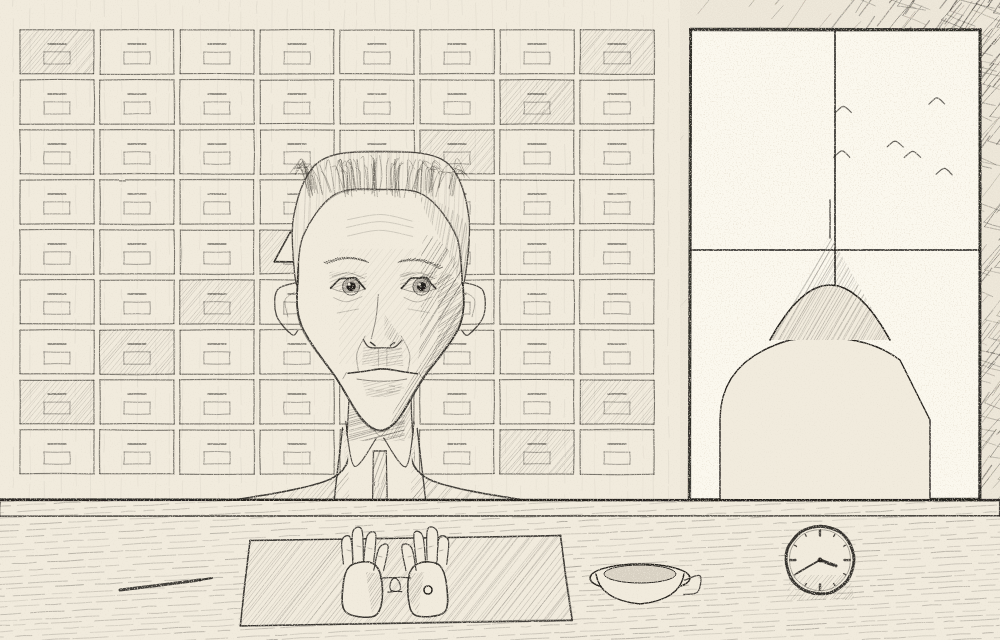
I had prepared a speech. I had gone over it in the tram, in the lift, in the pale cork lobby. I had planned to be firm. I had meant to say, I know what you've done, I know about the Corrections, I know about the photograph. But I sat in the soft chair with the cup in my hand and the sun on the side of my face, and I heard myself say, in a small and ordinary voice:
"Is she alive?"
David Miller did not hesitate.
"I don't know," he said.
He told me a great deal, in the next hour. I have written it down, as accurately as I can, and I do not think I have made it worse. If anything, I have made it better. He was a gentle and fluent speaker, and he never once raised his voice.
"Veyra is an old city," he said. "Older than the records. Some of the earliest burials in the cathedral crypt date from a time when there was no cathedral, and no city, only a ford. People have always known that there is something odd about this place. Our predecessors called it the Listening. It is not malevolent, I think. It is not intelligent, in the sense that you and I are. It is more in the nature of a... condition. A property of the ground." He turned his cup. "In the seventeenth century, they used to ring bells at night, to confuse it. In the eighteenth, they forbade the keeping of certain kinds of diary."
"Diaries?"
"A thing that is written, Daniel, is a thing that is remembered. A thing that is remembered, in a particular way, in a particular state of feeling, becomes something that the ground can hear." He looked at me. "I don't ask you to believe that. I only ask you to hear it. The Kessler Company was digging at the heart of a very old, very quiet, very patient thing, and in fifty-seven, they dug too deep."
"The shaft."
"The shaft." He nodded. "A hundred and twelve men on the night shift. At seventeen minutes past eleven, according to the company's own clock, the face of the south gallery fell in, and what they found on the other side was not a cavity. It was an audience." His voice did not change. "Every man on that shift heard his name. Called. From above. By his wife, his mother, his child. In the voice he loved best in the world. And every one of them answered."
I said nothing.
"The Department was founded the following spring," said David. "Under another name. By men who had stood at the mouth of the shaft all night and heard it, too. They'd understood something. A sound is only dangerous if someone is listening for it. And it listens, Daniel, with such appetite, to whatever we say with longing." He opened his hand. "So they began to take the longing away."
"By erasing people."
"By letting them be forgotten. Gently. Without ceremony." His eyes were steady. "If a mother does not remember her child, she cannot call for her. If a husband cannot recall his wife's name, he cannot call it in the street at midnight. I do not pretend it is a good thing. I pretend only that it works." He paused. "We have not lost a citizen to the Listening, in the ordinary way, in sixty years. Do you know how many people died in the ironworks in the year before that? In the year after? Do you know what came up, from beneath this city, in the winter of fifty-eight?"
"No."
"No. Nor does anyone. That is what I do for them." He spread his hands. "I make it so that they don't have to."
I looked at the cup. The tea had stopped steaming.
"You erased my sister," I said.
"I did not." He said it very softly. "I did not erase her. I was not there. It was done, I think, by your mother, and by a colleague, and by... a number of people, at a time of very great distress." He looked at the window. "But I did complete the work. I will not hide behind a technicality. I signed the order. It was my signature on the Correction."
"Why?"
"Because she was no longer yours," said David Miller.
I do not know how to describe the next minute. I had, I think, gone numb. I heard him go on, in the same pleasant, reasonable voice, and I heard the words as one hears the speech of a doctor in a room one has fainted in.
"Your sister went down the night she was twelve," he said. "She heard something in the street. We don't know what. A voice. You'd know better than I. And she answered. And it took her." He paused. "But she came back."
"I know. Three nights later."
"Do you?" He looked at me with sharp attention. "How do you know?"
I opened my mouth. I had spoken without thinking. I had said it as though it were a memory. I found, with a chill, that I could not have said where it came from. I had no recollection of her return. I only knew, suddenly, with a clarity like a slap, that she had stood on the doorstep at a quarter past eleven, in her yellow cardigan, and said Daniel? It's me, and that my mother had opened the door.
"I don't remember," I said. "I think I knew it. Just now."
"Yes." David nodded slowly. "That is what I was afraid of. You see, Daniel, you are very good at not remembering. We worked very hard on that. And I find that it comes undone very quickly, once someone has said her name in the right place." He leaned forward. "I'm going to offer you something. I want you to listen. It is not a threat. It is not a trap. It is the kindest thing I know how to do."
"What?"
"A procedure." He used the word with care. "One afternoon. A small quiet room. No pain. You would sleep. And when you woke, you'd go home, and you would find that you had never had a sister. You'd have no sense of a gap. You would not be the man who found the room on Marrow Lane, or heard the telephone, or went down to the pump house. You'd have your life. Your work, your flat, your tea." He smiled, a little sadly. "You would sleep well. I promise you that."
I stared at him.
"And Anna?"
"Would remain where she is."
"Which is where?"
"Beneath." He did not look away. "In the Quiet. In the place where forgotten things go. Where she will be, I imagine, for a very long time. But with no one to call her, she will not be in pain." His voice was gentle. "You must understand, Daniel. It is not a cruelty. It is the only mercy available. Every time you speak her name, it hears. Every time you grieve, it feeds. The more you remember her, the more it remembers you. And a thing that remembers a man, in that place, does not remember him kindly."
Now it remembers you.
I thought of the door. I thought of the footprints, pointing at me.
"No," I said.
"Daniel..."
"No." I stood up. The cup, still in my hand, tipped, and a thin brown stream ran down the back of my fingers onto the pale carpet. "I won't. You can't ask me. She's my sister. She called me. She's down there, and she's frightened, and you've been telling people for sixty years that the kindest thing to do for someone who's lost is to teach them to stop looking."
"I have forgotten my own," said David Miller.
It was said so quietly that I almost did not hear.
He had not moved. He sat with his hands folded on the desk, his silver head a little bowed, and the light from the long window lay across his face, picking out the lines. He looked suddenly very old. He reached into his breast pocket, and took out a leather wallet, and from the wallet a card, worn soft at the edges. He laid it face up on the blotter.
It was a plain white index card. On it, in a neat, firm, upright hand, was written:
You had a son. His name was Peter. He was nine. Do not look for him. You have already done this. You have done it eleven times.
I read it twice.
"I do it every spring," said David. "On the fourteenth of March. I've forgotten him eleven times." His voice was perfectly level. "Each time, I find the card in my pocket, and I read it, and I am very angry. I am very angry for about a month. And then I forget why." He took it back, gently, and put it away. "That is the cost. I do not ask you to pay it for a stranger. But for your sister, I think, it may be worth considering."
I could not speak. I stood in the middle of that large, pale, silent room with the tea cooling on my hand, and I looked at this courteous man who had destroyed my childhood, and what I felt, God help me, was not hatred. It was pity.
"I'm sorry about Peter," I said.
"Thank you." He smiled. "It is a thing I forget, but I would like to think he knows that someone said it."
"I'm still not going to do it."
"No." He sighed. "I did not think you would." He rose, with a slight stiffness, and held out his hand again. "Come back if you change your mind. The offer stands. I shall have my secretary see you down. I'm afraid I've a meeting. I'll be only a moment."
He went out through a side door. It closed behind him with a soft click.
I should say that I did not plan it.
I stood in the office alone for perhaps ten seconds. I heard the door shut, and his steps go away along a corridor, and then the long quiet of a room in a very large building. The pigeons turned over the square. The paperweight clock said twenty to four.
On the wall behind the desk was a row of filing cabinets. I had not noticed them before, they were the same pale wood as the panelling, and flush with it. They were small, shallow ones, each with a brass label holder. I walked along them, slowly, reading. ABBOTT. BAILEY. BARNES. Hundreds of them. Thousands, perhaps, in a long smooth wall.
CARTER, D.
It was at about the height of my hip. A shallow drawer. It was not locked. I do not think it had ever been locked. I put my finger to the handle, and it slid out on a silent runner, and the light caught the contents.
Photographs.
There were perhaps a hundred. They lay in neat stacks, face up, each in its own transparent sleeve. I picked up the first, and my fingers had gone cold and clumsy.
It was me.
It was a street I knew, in the rain, a man in a long coat, with his collar turned up, walking away from the camera. I turned it over. A pencilled date, six weeks ago. I picked up another. It was me in the tunnel, in the dark, in the glare of a flash, with my torch up and my mouth open. It was me at the bottom of a shaft. It was me at the window of my flat at night, in my shirt, with the lamp behind me. A hundred photographs. A hundred moments, each from some angle I could not have seen.
And others.
There was a beach. A pale flat shore under a white sky, with a man standing alone at the edge of the water. He was thin, and he was twenty, and he was crying. I had never been to that beach. There was a church I did not know, a nave filled with a bleak grey light, with a young man kneeling at the rail. There was a station platform in a foreign-looking city. A swimming pool. A hospital. A hillside. A bedroom.
I turned over a photograph, and looked at it, and could not breathe.
It was the porch of my mother's house. It was a day of high thin cloud. It was the same one. It was the same picture. The same step, the same green door, the same broken tile. But this copy was different. It was a larger print, and in it, the girl was not blank.
She was laughing. She had her head thrown back. She held my hand in both of hers, and I could see, with perfect distinctness, every freckle on her small nose, every curl of her crooked fringe. The gap in her teeth. The scar across her eyebrow. She looked, if anything, a little older. She looked, in the narrow slant of the light, as though she had been about to say something.
I had known that face for twenty-six years. I knew then that I would never forget it.
My hand was shaking so badly that the sleeve rattled.
There was one more. It was at the very bottom of the drawer, face down, in a sleeve of its own. I took it out. I turned it over.
It was a colour print, a recent one, taken from some distance. It showed a street at night. A long wet street, empty, glistening under the lamps, with the black mouth of a tunnel at the end. And in the middle of the road, a little to the left of centre, two men were standing side by side, looking toward the tunnel, with their backs to the camera.
One was tall, and silver-haired, and wore a pale grey suit. His hand rested lightly on the shoulder of the other.
The other was me.
I turned the photograph over. On the back, in the corner, was a date stamp: a small purple rubber-stamped box, the kind that clerks use. I read it. I read it again, and counted on my fingers, and the room began to tilt.
It was tomorrow's date.
"Ah," said David Miller, from the door. "You've found your file."
I swung round. He stood on the threshold of the side room, with a cup of tea in each hand, one for himself and one, evidently, for me. He did not look angry. He looked very tired. He looked, if anything, like a man who has come into his own kitchen and found the cat on the table, and cannot find it in him to shout.
"You may keep that one," he said. "I find you'll want it. I think you'll be asking me about it tomorrow."
I could not move.
"Goodbye, Daniel." He set the cups on the desk. "I'll see you at eleven-seventeen."