Chapter Five
The Man in the Recording
I got out at sixteen minutes past eleven, and that was the mistake.
The clocks in the tunnel had held me for what felt like three hours and was, by my telephone, nearer six. I followed the rails back through the dark with the torch clamped in both hands. Nothing followed me. Nothing whispered. The only sound was my own breathing, and the faint wet tick of the roof, and when I came to the foot of the shaft, and put my hand on the first cold rung, I understood that I had been holding my breath for an hour.
I climbed. At the top, I pulled myself over the lip and lay on the concrete in the pump house with my cheek against the grit and my heart going like a small engine. The roof had a hole in it. Through the hole, I could see a square of sky, black, with a few thin stars.
I looked at my phone. 23:16.
I did not have time to get to the tram. I did not have time to get to the gate. I lay on the floor of that ruined building, and I looked at the one minute I had left, and then I did the only thing that seemed available. I crawled across the floor to the back of the room, behind the bank of rusted valves, and wedged myself into the corner where the walls met, and pulled my knees up under my chin.
The rule is about the outside. I said that to myself, over and over. A roof is an inside. Four walls are an inside. I had no evidence that the Department had ever tested the distinction. I had only the plain brass plates beside the bridges, and the voice of a large tired man in a cardigan, saying: it's a technicality.
The bell at Saint Aldous was too far away to hear. I felt it instead, in the stone. A low, round, slow pulse that came up through the floor and into my spine, four times, and stopped.
For a while, nothing.
Then, very faintly, outside the fence, a woman's voice said, quite quietly, "Tom?"
It was not alarming. It was almost domestic. It had the weary tenderness of a wife at the foot of the stairs, calling a man who has stayed too long in the shed. "Tom, come in. It's getting cold."
And from somewhere else, a little way off, an old man's voice, cracked and patient: "Peggy? Peggy, love, where've you got to?"
And a child's. And a man's. And another woman, further away, calling a name I did not catch, and another, and another. They came out of the dark in the empty yard, from the lane and the waste ground and the long flat reach of the river, not loud, not urgent, but numerous, each one separate and each one so utterly and plainly loving that I pressed my knuckles into my mouth.
They called for an hour. I counted nine hundred and some voices before I stopped. They called in the voices of mothers, and husbands, and children, and each, I was sure, was the voice of someone I would have wanted to follow, if it had been my name.
Mine was not among them.
I waited for it. I want you to understand that. I crouched in that corner with my fists against my teeth and waited, and was almost glad when I heard footsteps on the gravel outside, light ones, a child's, running. They came to the door of the pump house, and stopped.
And no one said anything at all.
The silence outside the door was the most appalling thing I had yet heard. It was the silence of a person standing very close to a door with their face against the wood, listening for the sound of someone breathing.
I did not breathe.
At some point, I slept. I do not know how. When I opened my eyes, the hole in the roof was grey, and a bird was singing in the chimney, and the child was gone.
Michael Brown was waiting on the stairs outside my flat.
I came up from the street at half past seven, unshaven, filthy, in a coat that smelled of tunnels, with my notebook in one pocket and a ruined torch in the other, and found him sitting on the third step from the top with his elbows on his knees, eating cardamom seeds out of a paper bag. He was a tall, loose, tired-looking man in a grey duffel coat, perhaps twenty-nine, with a long face and a pair of deep sleepless eyes that seemed to have been lit from the wrong side. He rose when he saw me. He did not offer to shake hands.
"Daniel Carter," he said.
"Yes?"
"Michael Brown. You don't know me." His voice was dry and level, a voice used to giving instructions to frightened people. "I'm sorry about the hour. I wasn't sure when you'd be in. I've been to your office twice. They told me you hadn't turned up yesterday. They said you've never missed a day."
"Who are you?"
"I used to take calls." He rattled the bag. "Veyra Central Dispatch. Seven years. Ambulance, fire, police, the lot. I left two years ago." He gave me a look that was not quite an apology. "Mr. Carter, I'd like you to listen to something. I think you're going to say you've never heard it before. And I'd like you to do me the courtesy of being honest about that."
"Why?"
"Because it's your voice," said Michael.
He lived above a laundrette on Gasworks Road, in two rooms that smelled of steam and warm cotton. The window ran with condensation. He cleared a pile of newspapers off a table and set down a battered tape machine, a big grey reel-to-reel with a hinged lid, and beside it a shoebox full of cassettes in plastic cases, each labelled in a flat, careful hand.
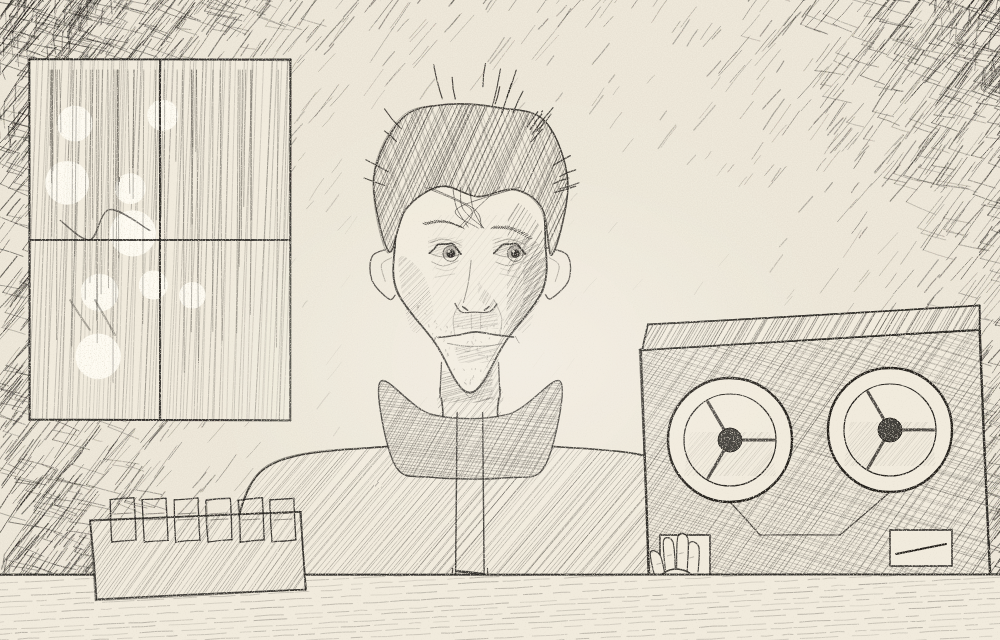
"Dispatch records every call," he said. "On the system. Then the system purges it after ninety days. That's the rule. But I'd been there long enough to know where the old machines were, and I got into the habit of copying certain ones." He threaded a spool. "Not the ones you'd think. Not the screaming. I took the ones that didn't fit."
"Didn't fit what?"
"The map." He pressed a switch. The reel began to turn, with a faint whirring. "In the last few years I was there, I took eleven calls from addresses that don't exist. Streets that aren't on any plan. The system would flash it up as unlocated. I'd ask for a location, and the caller would give one. I would look it up. It wasn't there." He sat back. "People get things wrong. They panic. They give the old name for a road. But these weren't mistakes. They were very exact. They gave a house number and a street and a district, and every time, the street was a real name. It was just that it wasn't on the right side of the river."
"What do you mean?"
"One of them was Marrow Lane," said Michael. "In a district called Under-Marrow. There isn't one."
The tape hissed. The little needle on the dial trembled.
"I'm not a believer, Mr. Carter," he said. "I'd like that to be clear. I don't hold with ghosts. I think there's an explanation. A hoax, a crossed line, an old exchange somebody's rewired. But I've played this seventy times, and I haven't found one." He lifted the lid of a small plastic case. "This is the fourth. It's dated the eleventh of June, four years after the girl went. The call is logged at twenty-three nineteen."
He pressed play.
The first sound was a click. Then, close, the clear rapid voice of a young man, who was plainly Michael.
"Veyra Central Emergency. What is your emergency?"
A pause. A whisper of static. And then, in the dim, hollow, resonant acoustics of a very small room, a man's voice, quite breathless.
"I don't... I'm not sure if this is the right number. I don't know who else to call."
My blood stopped.
I know my voice. Everyone thinks they do not, when they hear it recorded, they say it sounds thin, or too high. But I knew it the way you know your own hand in a dark room. It was lower than my voice is now. It was younger, with a catch in it, a kind of tremor of excitement and fear. It was unmistakably, inescapably, me.
"Sir, can you tell me your location?"
"Nine Marrow Lane. It's... it's my mother's house. I'm upstairs. I'm in a room, it's, it's a long story, I don't know how to... there's a girl here."
"A girl. Is she hurt?"
"No. No, she's fine. She's twelve." A laugh, shaky. "She's twelve and she's been twelve for four years, and I'm sorry, I'm not making any sense. She's asking to go back. She says it'll be quiet if she goes. She says her being here is making it worse, and I don't, I don't know what to..."
"Sir, I'm going to need you to slow down. What do you mean, go back where?"
A silence. In it, behind the voice, very faintly, I heard a second one. A younger one. A girl's, high and hoarse, calm in a way that made my skin crawl.
"Daniel. Give me the key."
And my own voice, so close to the microphone that it crackled:
"Not yet."
"Daniel. It's all right. You said you'd do it when I asked."
"I know what I said."
"I'm asking."
"Not yet. Not tonight. I'm not, Anna, I'm not ready, I can't just..."
The machine clicked. Michael had stopped it. He sat with his finger on the lever, looking at me, with the long tired face absolutely still.
"I've got twenty-one minutes," he said. "I'll spare you the rest. It goes on like that. He talks to the girl. He talks to me. He gives the address again. At the end of the call the line is cut." He paused. "Mr. Carter. I need you to tell me where you were on the eleventh of June, four years after your sister went."
I could not answer.
"Because the voice on this tape gives your name, and your mother's address, and I looked you up. You were twenty. You lived at home. You'd have been in the house." His eyes were steady. "I'm not accusing you of anything. I have no reason. I just need you to tell me that was you, or tell me it wasn't."
"It was me," I said.
"Thank you."
"But I don't remember." My throat was closing. "I don't remember any of it. I don't remember being on the telephone, or being in that room, or any of the four years she's talking about. I remember her going. I remember being sixteen, and she went, and then it's all..." I made a vague, helpless gesture. "I have four years that are only a sort of fog. I thought it was grief."
Michael nodded slowly, as though I had confirmed a figure.
"There's something else," he said. "I'd like you to listen again. Not to the voices. To the background."
He rewound the tape a little. He turned up the volume. The reels turned. And through the hiss, in the gap between the girl's request and my own refusal, I strained my ears and I heard it.
It was a very faint sound. A soft continuous breath, like a sigh drawn out too long. It was not static, static does not breathe. It rose and fell. It seemed to come from the far corner of the room in which the call had been made. And under the breath, so low and close and soft that at first I did not hear it as a sound, but as a pressure, a shape, in the silence, was a word.
Daniel.
It was whispered. It was whispered over and over, without hurry, without inflection, the way one says a name one is trying to remember.
Daniel. Daniel. Daniel.
"It wasn't there the first time," said Michael.
I looked at him.
"The first time I played this, there was nothing. I'd swear on it. Just the room, and the two of you." He pressed the heel of his hand against his eye. "I noticed it about the twentieth. A kind of breath. I thought it was the tape. The oxide wearing. I played it again, and it was louder. And again." He took his hand away. "I've been keeping a log. It's a little nearer to the microphone, every time. It's moved about four inches a week."
"That's not possible."
"No." He gave a short, dry, humourless laugh. "I've been saying that for two years."
I stared at the machine. The spool turned, steadily. The little green needle trembled against the dial.
"Mr. Carter," said Michael Brown, "I'm going to play it one more time. And I'd like you to listen very carefully. Because yesterday afternoon, when I was getting ready to come and find you, I played it for the first time in a month. And I noticed something."
He pressed the lever.
The room on the tape hissed into being. The click. The pause. My own young voice, Nine Marrow Lane. The girl. The key. And behind them, from the far corner, close, closer than before, so close now that I could hear the wet small click of a tongue against the teeth, the whisper.
Daniel, it said. And then, in the very next breath, in the same level, mild, listening tone, it added something that was not on any tape I have ever heard:
Tannery Row. Flat three. Over the umbrella shop.
I put my hand over my mouth.
He's listening, said the whisper. Now.
Michael Brown turned off the machine. He did it with great care. He took his hand away, and sat for a moment with both his palms flat on the table, and I saw that they were shaking.
"That's not what it said yesterday," he said. "Yesterday it only said your name."