Chapter Four
The Street Beneath the Street
James Wilson drew me a map on the back of a requisition slip.
He did it slowly, with a stub of carpenter's pencil, bent over the table in the room behind the reading room while the paraffin heater ticked and the faces of strangers' feet went by at the window. I had put the photograph back in its tissue. I did not want to look at it again. But I could feel it in the box under the table, a small cold weight, like a stone in a shoe.
"The ironworks," he said. "Kessler's. Everyone knows where it stood. East bank, beyond the gasometer. They pulled down the sheds in the sixties and put a car park over the yard, and then the car park was abandoned, and now there's only the pump house." His pencil made a small square. "The shaft was under the south shed. It was sealed in fifty-eight with eleven feet of concrete. That's the story."
"And the real one?"
"The real one is that the shaft was only one of nineteen." The pencil drew nineteen small crosses, in a ragged ring. "I've had the old surveys out. The Kessler Company cut galleries under the whole east bank. They ran to the river and under it. Then in fifty-seven something broke through. A pocket. A hollow that wasn't on any chart." He tapped the paper. "That's what the Department calls the incident. I call it a door."
"And Anna?"
James did not answer at once. He looked at the little map. Then he picked up a different pencil, a red one, and made a mark. And another. And another. I watched them multiply, in clusters, in lines, at the edges of the ring.
"These are last known addresses," he said. "Of everyone I've been able to find in the Corrections. Everyone who was struck. I've plotted them for thirty years." He sat back. "Do you see?"
I did.
It was not a scatter. It was a halo. The red marks lay along the streets above the galleries like beads on a thread, tight at the centre, thinning toward the edge, a slow spiral that ran out from the pump house across the river and up under Tannery Row and the terraces of Marrow Lane. A house on the corner of Marrow Lane had a mark on it. It was my mother's.
"They aren't random," I said.
"No. I think they go down." He passed me the slip. "I think that's where everything goes, in the end. I think the clocks are there."
"What clocks?"
"I don't know." He frowned. "I don't know why I said that. It's something my predecessor wrote, in a margin. The clocks are still running. I never found out what he meant."
I folded the paper twice. I put it inside my notebook, against the page where I had written nothing, because he had asked me not to, and I looked at the barred window. The light in it was already beginning to fail. The feet in the street had changed. They were quicker now, and nobody lingered. It was four o'clock. In seven hours the city would be shut.
"Mr. Carter," said James. "May I give you some advice?"
"Please."
"There's an entrance in the pump house. I've never been through it. I've never had the courage." He looked, for a moment, very old. "If you go, go now. Go while the light is in the sky. The rule is about the outside. Nobody has ever said what applies beneath."
"That's a technicality."
"It's all there is." He rubbed his face. "And if you hear her, down there. If she calls to you. I want you to listen to how she sounds."
"What do you mean?"
"The thing I was told, a long time ago, by a woman who'd lost her husband, was that it's best at frightened. It never imitates anger. It never imitates love. It does frightened." He looked at me. "Whatever it is. It knows what makes us come."
I went to the east bank on the number nine tram.
I sat at the back with the paper on my knee. A conductor in a peaked cap came down the aisle, punched my ticket, and moved on, and I watched the city thin out through the window. The terraces gave way to warehouses, and the warehouses to waste ground, and the waste ground to the long flat stretch of the river, brown and oily, with the gasometer standing up against the sky like a rusted drum. There were four other people on the tram. All of them got off before the last stop. Nobody wanted to be there when the light went.
The pump house stood alone at the end of a rutted lane, a squat building of brown brick with a slate roof half fallen in and a tall iron chimney that had lost its cap. A chain-link fence ran round it, bent flat in places. A sign on the gate said DANGER. NO ENTRY. VEYRA MUNICIPAL WORKS. It was so old that the paint had flaked to the grain.
I stood in front of it with my hands in my pockets.
The sun was low. The shadow of the chimney lay across the whole yard like the hand of a clock. I looked at my watch. It said ten past five. I looked at the sky, which was a hard thin lemon yellow, streaked with cloud. I told myself that it was a perfectly rational plan. I would go down. I would look. I would come up again, and take a tram, and be home by eight with an account of what I had seen, and perhaps by morning I would be able to read it as one reads a description of a dream.
I climbed through the fence.
The door of the pump house hung on one hinge. Inside was a single room, bare, with a floor of cracked concrete and a smell of cold iron. A bank of rusted valves ran along one wall. In the middle of the floor was a square iron plate set into the concrete, with a ring in it, and the ring had been pulled up, and the plate lay a foot to one side.
Under it, a shaft. A narrow one, with a ladder.
I put my head over the edge, and a breath came up. It was very faint. It was the breath of a very large cellar: cold, damp, mineral, with an undertone I could not name, that I thought at first was oil. It was not oil. It was something sweeter. The smell of an old library. Of paper left in a closed room for a hundred years.
I took out the torch.
I climbed down thirty-one rungs. I counted. At the bottom, my shoes touched stone, and I switched on the beam, and found myself standing at one end of a tunnel.
It was brick, and it was wide. It was wider than any tunnel I had expected, perhaps twelve feet across, with an arched roof and a shallow channel down the centre where water had once run. A pair of narrow rails ran along it, red with rust. The walls were furred with a pale growth that sparkled in the beam. It went away ahead of me into a blackness so complete that the torch seemed to be shining into a wall.
I walked.
I will tell you that I was not afraid. I was something else. I was attentive. I walked slowly, with my hand on the damp brick, counting my steps, and every few yards I stopped and listened. There was water somewhere, a long way off, dripping. There was the small tick of cooling stone. There was, now and then, the long soft sigh of air through a vent. It was an old place and an empty one, and the only thing in it that moved was the beam of my torch.
I came to the first clock after a hundred and forty paces.
It was set in the wall at head height, a plain white-faced station clock in an iron case, with a brass rim and black Roman numerals. A little rust had crept across the glass. It was the sort of clock you see over the platform in a country railway station, solid and unlovely, made to be looked at by tired people.
It said seventeen minutes past eleven.
I looked at my watch. Twenty-six minutes to six. I looked at the clock again. It was stopped, I thought. Of course it was stopped. It had been stopped for fifty years.
I walked on.
There was another at two hundred paces. A round one, with a cracked face and a tin surround. Another at three hundred. A square one on a bracket. A cheap kitchen clock with a plastic frame. An alarm clock on a shelf cut into the brick. A pocket watch on a nail, hanging by its chain. Some had been bolted to the walls and some had been set on ledges, and some, as I went deeper, lay on the floor of the tunnel itself, face up, in a long untidy line, like a trail dropped by a person who wished to be followed.
They all said the same thing.
I stopped counting at forty. After that, I walked in a kind of trance, with the torch moving over them one after another, glass and brass and enamel, a long procession of white faces, each with its two black hands laid in the same attitude, the minute hand a little past the three, the hour hand a little past the eleven. A line of small clenched fists, held up in the dark.
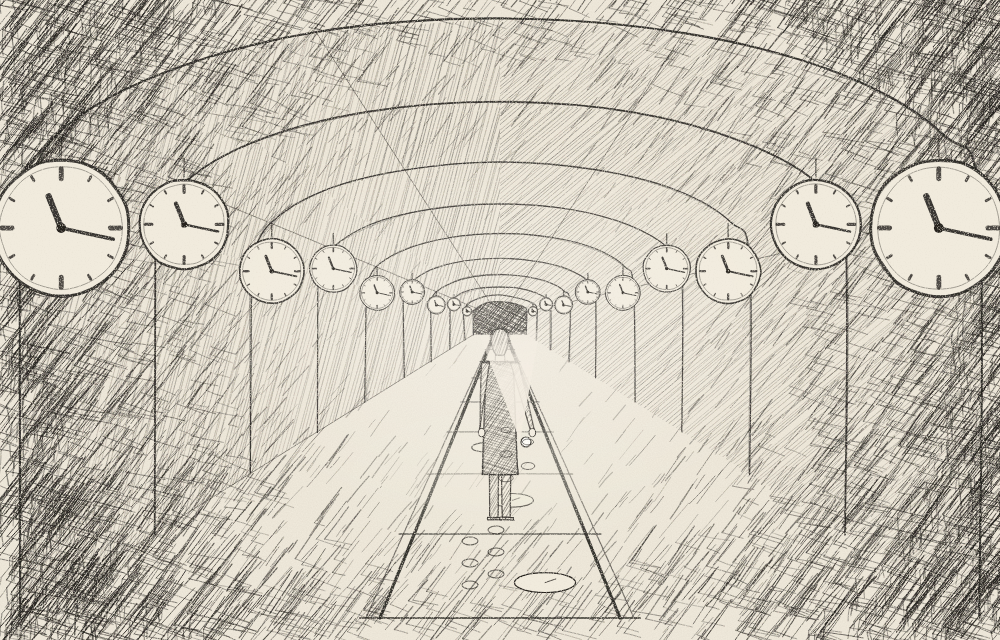
Seventeen minutes past eleven.
I do not know how long I walked. I know that at some point I looked at my watch, and it had stopped.
I tapped it. I held it to my ear. It did not tick. It said eleven-seventeen.
It was a plain steel watch with a leather strap that I had bought myself, six years ago, in a shop on Low Market, and it had never lost a minute in its life.
"Daniel."
I stopped. I did not breathe.
It was ahead of me, in the dark, a long way off. The torch beam, when I lifted it, went away down the tunnel and found only wet brick, and rails, and the endless white faces of clocks.
"Daniel. Please."
It was her.
There was no mistaking it. It was a girl's voice, small, hoarse, very frightened. It carried along the tunnel with a clarity that was almost unbearable, as though the vault had been built to bring it to me. I felt my knees give. I put out a hand and found the wall.
"Daniel, don't. Don't come any further. Please. Don't let them remember me."
"Anna?" I could hardly get it out. "Anna, where are you?"
"Don't let them remember me."
"I don't understand. Who? Who's them?"
"It's listening." The voice had dropped. It was almost a whisper now. It seemed to be coming from the wall itself, from the bricks at my shoulder. "Daniel, it's listening. It hears when you say my name. Every time you say it, every time you think it, it hears. It's so loud. You've no idea how loud you are. You're the loudest thing in the city."
I thought of what James had said. Listen to how she sounds.
She sounded exactly as she had sounded at ten years old, the night of the thunderstorm, when she had crept into my room and sat on the end of my bed in the dark and said, in just that voice, Dan, there's a noise.
She sounded perfectly, entirely, heartbreakingly frightened.
It does frightened, said James, in my head.
"Anna," I said. "Say something that only you would know."
Silence.
It went on for a long time. A drip fell somewhere. I stood, and shook, and the torch trembled in my fist, and I realised what I had done. I had asked it a question. I had given it a test, and a test is a door, and I did not know what would come through.
"The marble," said the voice. "You gave me the blue one. You said it was lucky. You said, don't lose it. And I didn't." A pause. A small wet breath. "I never lost it, Dan. I hid it in the wall."
My eyes were burning.
I found it, I thought. I found it on the floor of her room this morning.
It could have been in my head. It could have been any of a dozen things. I did not know. I knew only that I was twenty-six years old, in a brick tunnel under a city, with my watch stopped, and my sister was speaking to me out of the dark and I wanted, with the whole of my body, to run toward her.
"Where are you?" I said again.
"I can't tell you. It'll hear." Her voice was moving. It seemed to come from further off, now, from some place down the line of the clocks. "Go back. Go up. Please. If it finds you down here, it will have you. It's been waiting so long. And it's so hungry, Dan. You can't think how hungry."
"I'm not leaving you."
"You already did."
It was said without any malice. It was said flat, the way one says a fact. It hit me in the stomach.
"Anna..."
"Don't let them remember me," said the voice, once more, very faint. And then, in a different tone, so quiet that I might have imagined it, so quick that it was gone before I knew I had heard: "It's behind you."
I did not turn.
I want to be exact. I did not turn, and I did not shine the torch, and I did not shout. I stood perfectly still. And in the stillness I listened, and I heard what had been there for some time, and which I had taken, until that moment, for the echo of my own feet.
A step.
It was very soft. It came from the dark at my back, perhaps twenty yards off, on the stone. It was the sound of a shoe, set down carefully, and lifted. And then another. They were slow. They were even. They had the quality of a walk that has no particular wish to reach you, which is simply keeping pace.
I took a step forward.
Behind me, it took a step.
I stopped. It stopped. I heard it, in the half-second after my own foot came down, the small dry tick of a heel settling. It was not an echo. An echo repeats. This did not repeat. It followed. It had waited for me to finish, and then it had done the same.
I walked.
I walked faster. The torch beam bobbed on the brick. The clocks went by, one after another, white and silent and blind. I heard it hasten. Not much. Only a very little, a hair, so that it never closed the gap, and never fell away. I was a man walking in front of his own footstep. And with every pace, the thing behind me seemed to learn me, to take the rhythm of my breath and the slight drag of my left foot, until I could not have told you where one of us ended and the other began.
I had begun to run when I heard the whisper.
It was very close. It was at my shoulder. I felt the cold of it on my cheek.
"Daniel."
It was not her voice. It was not my mother's. It was nobody's. It was simply a voice, a smooth, mild, pleasant, ungendered sound, the voice of someone reading out a name from a list. And it said it again, from the right, and from the left, and from above, as though the tunnel were full of mouths.
Daniel. Daniel. Daniel.
I ran. I do not remember the rest, except in pieces. A junction, with three arches. A low door. A long straight, in which the rails ran away like parallel scars. A great chamber with a vaulted roof, where the torch beam went up and up and found nothing, and I ran across the floor of it with my own shadow leaping and swooping against the far wall, enormous, and then, for one second, wrong. For one second, in the tumbling light, my shadow had stopped, and was standing quite still on the wall, watching me go.
At the far side was a wall. It was a blank brick wall, with a rusted gate set into it, chained shut. I flung myself against it. I shook it. The chain rattled. I turned, with my back to the bars and the torch in both hands, and swung the beam round the chamber.
It was empty.
The floor was empty. The vault was empty. The sound had stopped. There was nothing in the great dark hall but the dust, and the distant sparkle of the damp, and a faint, slow, patient drip.
It was a long time before my heart slowed.
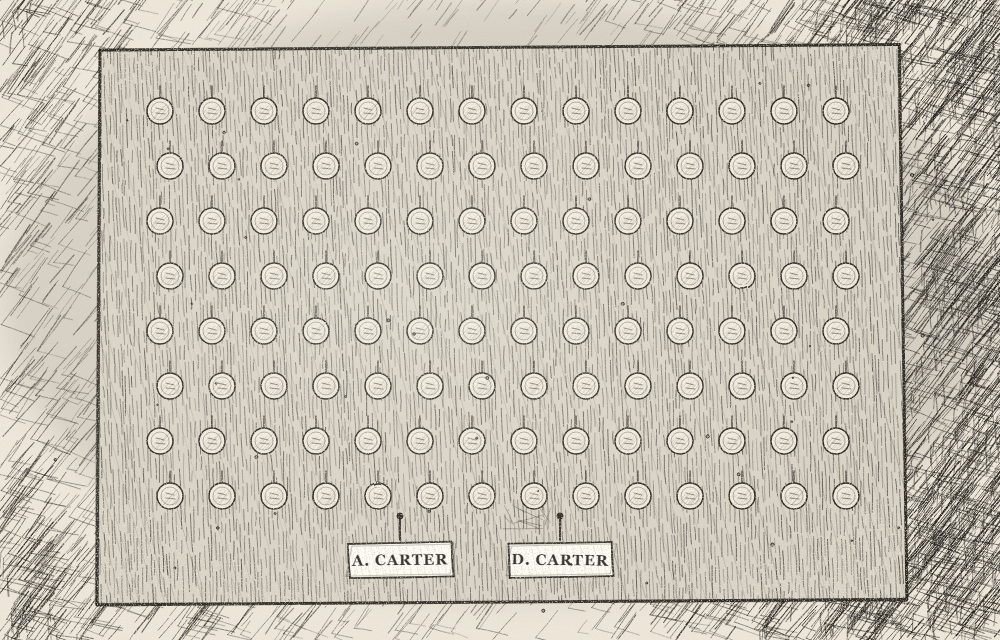
On the wall beside me, at shoulder height, was a board. I had not noticed it when I ran. It was a big flat board of black wood, set into the brick, the sort of thing that hangs in the entrance of a factory. It was covered in rows of small brass hooks. And on the hooks, one on each, in neat ranks, hung small round tags of brass, each about the size of a coin, each stamped with a number.
A tally board. The kind that the men take down when they go on shift, and put back when they come off, so that the foreman can tell at a glance who is still below.
I counted the tags. It took a minute. A hundred and twelve.
And at the bottom, apart from the others, beyond the last row, on a hook that had been newly screwed into the wood, hung one more. It was smaller than the rest, and thinner, and it had been polished until it shone. It had no number. It had a name, stamped in capital letters by someone with a hand-punch, each letter slightly crooked.
A. CARTER.
Beside it, there was another hook. It was empty. The screw was bright. The wood around it was freshly scored, as though the hook had been put in only a day or two ago, and the brass ring beneath it had been polished, too, ready, waiting for something to be hung.
I do not know how long I stood there.
I remember that I put out my hand to touch the tag, and could not. I remember that behind me, a very long way back, in the black throat of the tunnel, a single clock began, very quietly, to tick.
I turned. I shone the torch the way I had come.
Down the middle of the tunnel, in the grey dust, were two lines of footprints. I knew one set. They were mine. I had walked in the middle, a little to the left, with the drag of the left foot. They came out of the dark and across the floor of the vault, in a straight, frantic line, to where I stood.
The other set came toward me.
They were exactly the same. Same shoe. Same length of stride. Same slight scuff on the left. They were my own footprints, one for one, in the dust of a place I had never been, a little to the right of mine, going the opposite way. And they stopped at the edge of the vault, no more than eight feet from where I stood, as though whoever had made them had come that far, and had been content to arrive.
They were pointing at me.