Chapter Three
The Archive of Nobody
It was only the wind.
I have told myself that for eight days. I ran down the stairs with the torch swinging, and the front door stood wide on the dawn, and the cold came in over the step with the smell of wet slate and coal smoke, and there was nobody on the path. Nobody on the lane. The street lamps had gone out one by one and the sky over the roofs was the colour of a tin plate. A milk cart rattled somewhere far off. A cat came down the wall of number twelve and looked at me with its head tilted and went on about its business.
The slippers were gone. The voice was gone. The writing on the door was gone.
I stood on the inside of that door in the grey light and ran my hand over the paint. It was smooth. It was cream, and old, and a little yellowed at the edges, and if there had ever been pencil on it, it had been rubbed away so cleanly that the wood had not even a shine. I took out my phone and photographed it. Then I looked at the picture. The door in the picture was clean.
I went back up. I will not tell you what it cost me. The room was still there. The wardrobe stood where I had left it, a foot from the wall, and the little door hung open in the torn roses, and when I put my head through, the starfish was dark, and the bed was cold, and the calendar was open to the same month. I measured it, because I had said I would. Twelve feet, four inches. I measured Mrs. Ashby's kitchen from her side, in the afternoon, by pretending to deliver a parcel, and it was twelve feet, six. Inside her kitchen there was nothing but a table and a canary.
The grave had changed back. DANIEL CARTER, on the wall, in the corner. I photographed it again. The photograph said ANNA.
I put the yellow button in an envelope, and the blue marble in another, and I labelled both, Marrow Lane, upper floor, 3 a.m., found, and I put them in my coat. Then I washed my face in the kitchen sink, in cold water, and for a long moment I looked at myself in the black window over the taps.
You are not well, I told the man in the glass. You have not been sleeping. This is what grief does, at twenty-six, after four years. You have constructed a room.
He said nothing. He had the sense, I noticed, not to argue.
And then I did what a clerk does. I went to look it up.
The Municipal Archive of Veyra stands at the top of Gantry Street, on a rise, looking down over the roofs like a heavy man on a bench. It is a long flat building of black stone, with a portico of six plain columns and a flight of broad steps that no one has ever, so far as I know, run up. There are lions at the bottom. They have been worn smooth by the rain until they look less like lions than like two large dogs that have fallen asleep and been forgotten.
I had been there once before, with my mother, when I was eleven. She had gone to consult a ledger. She had left me on a bench in the entrance hall with a comic book, and I remember being struck by the quiet, the particular dense, cotton-wool quiet of a building full of paper. It smelled of dust and lamp oil and the faint sweet decay of old glue.
It smelled the same. I went up the steps at ten past nine on Tuesday morning, past the lions, with my tie knotted tight and my notebook in my pocket, and I pushed open one of the enormous doors and went in.
There was no one at the desk.
The hall was long and cold. A clock ticked. A line of oak cabinets with brass handles ran along one wall, their drawers labelled in a faded copperplate that nobody had updated in sixty years. I went to the desk and rang the little bell, and the sound fell into the stillness like a pebble into a well. I waited. I rang again.
"We're closed to the public."
The voice came from above me. I looked up. There was a gallery that ran round the hall at the height of a first floor, with an iron rail, and at the rail, with a stack of box-files in his arms, stood a very large man.
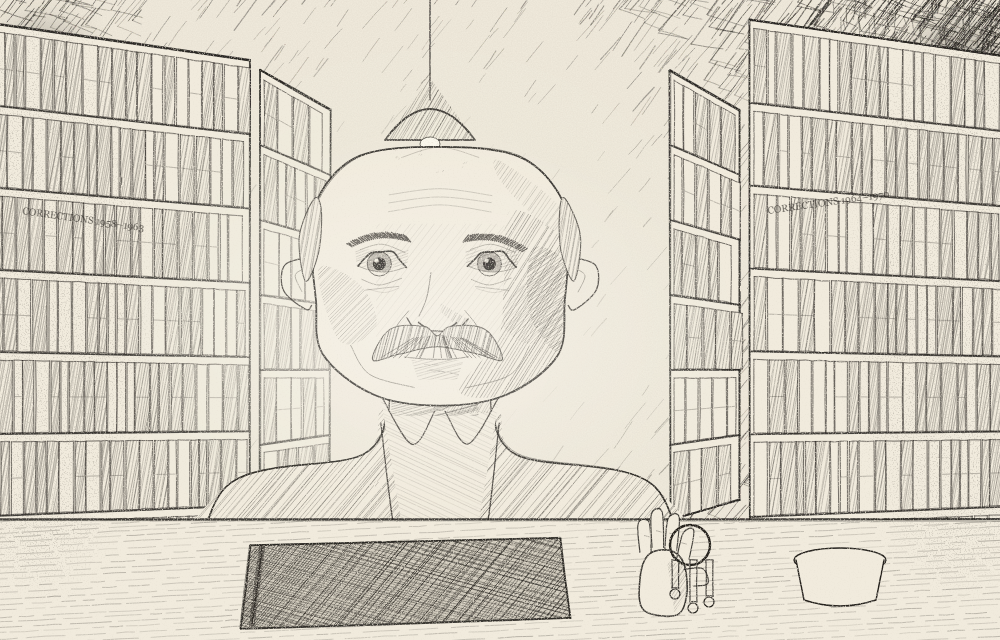
He was perhaps sixty-eight. Broad, slow, thickly built, in a brown cardigan that had been darned at both elbows and a pair of corduroys gone shiny with age. He had a grey moustache, a bald crown, and a bunch of brass keys at his belt that clinked as he breathed. His face was wide and heavy and tired. It was the face of a man who spends his days with things that cannot answer back.
"I'm sorry," I said. "I rang. I'd like to see the civil registers."
"Closed to the public."
"I'm not exactly the public. I mean, I work in records. At the rail depot. I'm a clerk." I held up my identity card as if it were a pass, which was absurd. "It won't take long. I only need to check one entry."
He looked at me for a long time.
It was not a hostile look. It was something more disquieting: a look of weary, wary, almost sorrowful attention. He looked at me as one looks at a man one has been expecting for years and had hoped, on the whole, would not come.
"What's the entry?" he said.
"A birth. A girl. Anna Carter."
I saw it. I want to be exact. I saw something go through the big face, a small, hard contraction, the way a wince goes through a man who has trodden on a splinter. Then it was gone. The keys clinked.
"No," said James Wilson. "There's no entry."
"You haven't looked."
"I don't have to." He put down the box-files on the rail. They made a flat dry sound. "Go home, Mr. Carter."
I had not told him my name.
It took forty minutes.
I am not proud of it. I stood in the middle of that hall, in the cold, with my identity card in my hand, and I argued. I used every argument that a mild and orderly person can bring to bear on another: that I was a citizen, that the archive was a public body, that there was a form I could fill in, a fee I could pay. He stood at the rail with his heavy arms on the iron and said nothing. When I ran out, I did something I had not planned.
I took the button out of its envelope and held it up.
"She wore a yellow cardigan," I said. "It had one button missing. I found this in my mother's house, this morning, in a room that doesn't exist. I have a telephone with a call on it from a line that was cut four years ago. I have a photograph of a drawing that says one thing when I look at it and another when I don't." My voice was unsteady. "I know how this sounds. I know. I'm a person who believes in records. I haven't got anything else. I would just like somebody to tell me that I am mad, with a stamp on it, and I will go away."
For a while there was no sound. Somewhere in the building a pipe knocked.
Then James Wilson said, in a low, flat, curiously gentle voice, "Wait there."
He went away along the gallery. I heard a door, and a bolt, and the long metallic rattle of the keys. When he came down the stairs, he came slowly, one hand on the rail, and he walked past me without a word to the great doors and shot the bolts and turned the heavy brass sign that hung on the inside.
CLOSED.
"You'd better come into the back," he said. "And you will have tea. And you'll sit, because you're going to need to. And before I show you a single thing, Mr. Carter, I'm going to ask you to do one for me."
"Anything."
"Don't write it down."
I stared at him. The notebook was in my breast pocket. I could feel the corner of it against my ribs.
"Not here," said James. "Not yet. I've found, over the years, that the paper in this building is not always..." He paused, searching. "Loyal."
He kept a room behind the reading room that was not on the plan.
You reached it through a door disguised as a cabinet, and down four steps, into a long low room with a sloping floor and a single barred window at the pavement level, through which one could see the feet of the people going by in Gantry Street. A paraffin heater stood in the corner. A kettle on a gas ring. A table. Shelves, floor to ceiling, of identical green cloth-bound ledgers, with white labels, in a blocky hand: CORRECTIONS. 1958–1963. CORRECTIONS. 1964–1970. They went on, in order, round the whole room. The last was labelled with the current year.
"I started the first of these in nineteen seventy-nine," said James. He lowered himself into the chair with a grunt. "Before that, there was a man called Pryce. He had it in his head, I think, that somebody ought to. I took it over when he retired." He put two cups on the table. They were thick white ones, the sort used in station cafés. "It's very simple. Whenever I find that a record has been changed, I write it down. What it said. What it says now. The date I noticed."
"Changed how?"
"Every way there is." He poured. "Names rubbed out. Names put in. A birth certificate that was there on Thursday and is gone on Friday. A death certificate for a man who was alive on Friday, and is alive on Saturday, and who finds on Monday that his wife has been drawing his pension for six years." He looked at the cup. "Whole families. A street in Low Market, nineteen eighty-eight. Eleven households. The rate books show the houses, and the houses show no one. There is a gap in the numbering. Number fourteen follows number seven."
"What happened to them?"
"That," said James, "is the question." He looked at me. "I'll tell you what I know. It isn't much. Things go. They go without noise. It isn't theft, or fire, or damp. It's tidier than that. Someone comes in the night, I think, or something does, and the records are simply... corrected." He put his hands on the table. They were huge hands, scarred, spotted, trembling very slightly. "And the people forget. That's the horror of it, if you want to know. It isn't that they go. It's that nobody misses them."
I held my cup in both hands. It was very hot.
"I missed her," I said.
"Yes." He nodded. "I think you did. I think that's why you're here." He reached down, and took from under the table a ledger that was not one of the green ones. It was black, and thinner, and its spine had been broken and mended with tape. He laid it flat in front of him and rested his palm on the cover as a man rests his hand on a Bible.
"Carter," said James. "Anna Marion. Born sixth of June, to Helen and Thomas Carter. Saint Aldous Maternity. Weight seven pounds two."
I could not speak.
"I have it in my own hand. Copied from the register on the nineteenth of November, in the year after she went. I went in on a Sunday, with a torch, and I copied her out while the page was still there." He opened the book. "The page was gone by the Tuesday."
He turned it round and slid it across the table.
I looked.
It was a column of names. Perhaps forty of them, in a cramped neat blue ink. Each had a date after it, and a short note: struck. struck. struck, school register. struck, parish. struck, medical. And halfway down the page, below a Prentiss and above an Ouseley, in the same small, careful, unemotional hand:
CARTER, Anna M. b. 6 June. Struck, all registers. By order of Dept. of Civic Memory (verbal). 19 Nov.
I put my finger on it. The ink was old and brown. It had gone a little soft at the edge, as ink does on paper that has been much handled. It was real. It had been written by a man, in a room, with a pen, on the nineteenth of November ten years ago.
I had waited ten years for that line.
I do not know what my face did. I know that James looked away.
"Thank you," I said, and my voice cracked in the middle. "I'm sorry. Thank you. I only needed to... I thought I had made her."
"You didn't."
"I know that now." I laughed, a short wet breath. "Do you know I've spent ten years believing that I had a gap? That there was a place in me where something had been left out, and I had filled it in with a girl. I thought it was a kind of grief that had gone wrong." I wiped my face with the heel of my hand. "I wasn't mad."
"You were not." James reached across the table and, with a delicacy remarkable in such large fingers, shut the ledger. "But I have to tell you, Mr. Carter, that I'm not done. I haven't shown you the worst."
It was in a long flat box under the heater.
He did not open it at once. He sat with his hands round it, looking at the lid, with the same expression I had seen in the hall, and I understood that for some reason he did not want to.
"This came in four years ago," he said. "March. The week your mother died."
"My mother?"
"It was sent over from the Department, in a bundle of papers for pulping. A clerk's error, I suppose. It had been filed with the rest, and it should have been destroyed. I'm not sure I know what I was thinking." He gave a heavy shrug. "I kept it. I've kept it ever since. I don't look at it often."
He lifted the lid.
Inside, in a nest of tissue, lay a photograph.
It was a snapshot, small and square, with a white border, the sort that stopped being printed when I was a boy. A little brown at the corners. It showed the front of a house, a narrow brick house with a green door, on a day of high thin cloud. A garden gone slightly wild. A broken tile on the path.
My mother's house.
And on the step, side by side, squinting a little into the light, two people.
One was a young man of twenty or so, tall, thin, awkward, with a shock of dark hair and a cardigan too big in the shoulders. He had his hand raised to his brow against the sun. I knew him at once. I had seen him in the shaving mirror every morning for six years, only younger, and happier, with an easy, lopsided smile that I had not worn in a long time.
I did not remember having it taken.
And holding his other hand, with both of hers, as one holds a rail on a boat, there stood a little girl.
She was perhaps twelve. She came up to his shoulder. She wore a grey jumper with a darn at the elbow, and under it the collar of a yellow cardigan, and she had short dark hair that ran uphill across her forehead. There was a scar through her left eyebrow. She was laughing. She had her head thrown back, and her mouth was wide open, and there was a gap where a back tooth should have been, and the whole of her small bony body was bent toward my brother's, my own, I mean my own, with an unself-conscious confidence that I could not look at for long.
I turned the photograph over with a hand that did not feel like mine.
On the back, in blue ballpoint, in a hand I thought I knew: Daniel & Anna. Marrow Lane. June. And a year.
It was the year I was twenty. It was four years after the night she disappeared.
"That's not possible," I said.
"I know."
"She was twelve when she went. She would have been sixteen. She would have been..." I stopped. "She hasn't changed. She's the same. She's exactly as she was."
"I know," said James again, very softly.
I looked at it again. I looked at her laughing, mouth open, her hand in my hand, and I tried to find a flaw in it. A mark. A line of retouching. A blur of the kind that comes with a double exposure. There was none. It was a perfect, sharp, ordinary photograph of two people on a doorstep, a summer ago. Four summers, rather. Ten years after the first.
"I don't remember," I said. "I don't remember this day. I don't remember being twenty on that step. I don't remember her at all, after twelve."
"No."
"How can I not remember?"
James Wilson did not answer. He had been looking at the photograph, I realised, not at me, with his big grey face gone very still, and now, as I raised my eyes, I saw that something was wrong with his expression. It had slackened. His moustache trembled. He put out one thick finger, hesitantly, and held it a half-inch above the print, over the face of the child, as though afraid to touch.
"Mr. Carter," he said, in a changed voice. "Why doesn't she have a face?"
I laughed. I did not mean to. It came out of me like a hiccup.
"What?"
"The girl." His finger shook. "There's nothing there. It's blank. It's just... skin." He swallowed. "I've looked at this a dozen times. Every time, I look away, and I look back, and it's a little worse. Today it's gone altogether."
I looked down.
She was laughing. She had her head thrown back. There was the scar through her eyebrow, the crooked fringe, the gap in her teeth. Every feature was there, as sharp as a pin. I could count her lashes.
"She's fine," I said. "James, she's perfectly... it's all there. Look. You can see her teeth."
He did not look. He had closed his eyes.
I understood, then, that he was not joking. I have never seen a man so frightened of a piece of card.
"Look away," said James. "Please. Count to five. And then look back."
I do not know why I did it. I think that I had begun, by then, to be afraid, in a clear, detached, procedural way, as one fears a diagnosis. I put the photograph on the table. I looked at the wall. I looked at the green ledgers. I counted, in my head, slowly, as I had counted rings. One. Two. Three. Four. Five.
I looked back.
My own face was there, young, and lopsided, and smiling. My shoulder. My raised hand. The cardigan. The step, and the broken tile, and the green door.
And at my left, where a girl had been, with her head flung back, laughing, holding on to my hand with both of hers, there was a small figure in a yellow cardigan, and a grey jumper, and short dark hair.
Where her face should have been, there was nothing. Not a shadow. Not a smear. Not a gap. There was only a smooth, pale, unmarked oval, like the surface of an egg, and the curve of the jaw, and the line of the neck going down into the collar. It was as though she had been drawn very carefully by someone who had simply declined, at the last, to draw the rest.
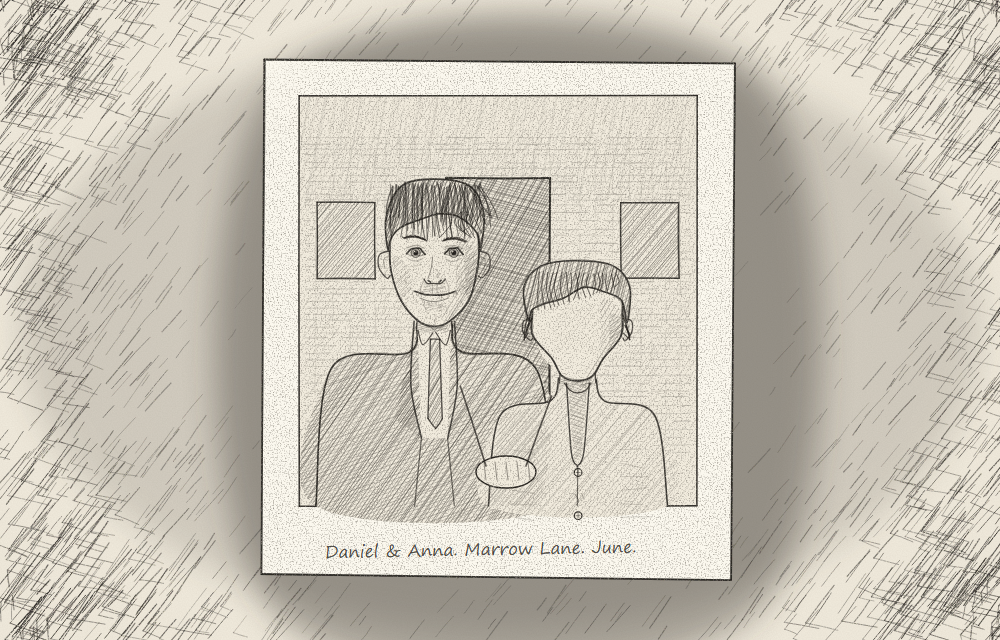
She was still holding my hand.
The cold, as I looked at it, went up my arm from the palm.