Chapter Two
The Missing Room
I counted the rings.
It was something to do. I stood in the hall of my mother's house with the torch in my fist and my back to the door, and I counted, because counting is what I do when I am afraid, and because a number is a number whatever is making it. The telephone rang in the dark with a thick, old, mechanical clang, a hammer on two brass bells, and each ring went through the empty house and came back changed.
Nine. Ten. Eleven.
The receiver lay beside it on the table, face up, in its oval of cleaned dust. A telephone with its handset off the hook does not ring. It cannot. I knew that. I had known it since I was six years old. And the cord ended on the table in two grey copper tongues, a hand's width from the wall. It was not connected to anything. It was not connected to the world.
Twenty-three. Twenty-four.
I did not lift it. I thought of the promise, and I thought of the voice on the hill, and I thought, quite calmly: whatever is on the other end of this is not on a line. I stood and let it ring. My shadow stood out on the wall behind me, huge and very still.
Thirty-eight. Thirty-nine. Forty.
It rang forty-one times. Then it stopped, in the middle of a ring, with the hammer lifted, the way a man stops when he has seen that no one is going to answer.
The silence that followed was not empty. I have tried to describe that to the people I have told, and I have not managed it. It was like the silence in a room when a person has just stopped speaking. It had a shape. It had an edge. You could feel where the voice had been.
Somewhere above my head, a drawer slid open.
I went up the stairs because I could not stay where I was.
I will not pretend there was courage in it. It was something much more ordinary. The hall behind me had become impossible, the door with its two sentences, the telephone with its warm receiver, and the house above me, though it was dark and possibly worse, at least had the quality of a place that might contain an explanation. You will understand this if you have ever been in an accident. There is a moment when the body chooses the direction of the sound.
The stairs were as I remembered. The ninth one creaked. The banister was tacky with dust under my hand. At the top, the landing ran left and right, with four doors on it: the bathroom, my mother's room at the front, my own old room at the back, and between them, narrow and brown, the door of what my mother had always called the box room.
That door was ajar.
It had not been ajar when I was a boy. It had been shut. It had been, I think, locked, and the key had hung on a nail by the bathroom, and in all the years I lived in that house I do not believe that I was ever once inside. My mother kept sewing things in it, she said. Old curtains. Things for the church sale. I had had no interest in it.
I pushed it with my fingertips, and it swung inward on a slow, dry hinge, and the beam of the torch went in ahead of me.
It was a sewing room. A small, narrow, ordinary one. A treadle machine under the window, with its iron foot, and a dress-form in the corner with a calico shroud, and shelves of folded fabric gone yellow with age. There was a smell of camphor and cold. In the middle of the floor lay the drawer.
It had been pulled out of a chest and set down neatly on the boards, the way one does when looking for something in a hurry and then losing the nerve. It was full of buttons. A great many buttons, hundreds, in a heap, brass and bone and mother-of-pearl, and on the very top of the heap, as if it had been put there to be found, lay a single yellow one.
A small flat yellow button, with four holes. The thread was still attached to it, a few stiff strands of white cotton, torn rather than cut.
I picked it up.
It was cool and light and quite ordinary. I turned it over in my fingers. I had to hold the torch against my ribs to do so, and my hand shook, and the little disc caught the beam and threw back a blur of buttery light.
A yellow cardigan, I thought, with one button missing.
I put it in my pocket. I did not know why. It felt as though, if I left it in that drawer, it would stop being true.
My mother's room was at the front of the house.
I went in because I did not want to leave anything behind me, and because I had a feeling, which I could not have justified, that the thing I had come for was in there. The bed had been stripped. The mattress was bare and striped like a tiger. The curtains had been drawn and the heavy brown wardrobe stood against the party wall, great and dark, a piece of furniture the size of a small cart, which my father had carried up those stairs alone, in the first year of their marriage, and which no one had ever moved since.
I had always thought of it as a part of the wall.
I do not know what it was that made me look at the floor. Perhaps it was only that I was tired. But as I turned toward the window the beam of the torch fell across the boards in front of the wardrobe, and I saw the marks.
Four long curved scratches in the varnish. A pair at each foot. They were old. They had gone grey with dust at the edges. But they were unmistakable: the grooves a heavy thing leaves when it has been dragged, again and again, over the same short distance.
Out. And back.
I stood for a while looking at them.
Then I put down the torch on the bed so that its light ran along the floor, and I put my shoulder against the wardrobe, and pushed.
It would not move. I braced my feet, and pushed with everything I had, and felt the wood groan against my collarbone, and the whole great box shifted a quarter of an inch and stopped. I tried again. It took a long time. Each time it moved, it moved only a little, with a deep bruised scrape, and each time I thought, this is madness, it is three in the morning, I am a clerk. But it moved. It went on moving. And in the end, with a long shriek of wood on wood, it slid out from the wall by perhaps two feet and stood there, wavering, with its back to me.
I picked up the torch and went round behind it.
Wallpaper. Brown roses on cream. It was the same pattern as the rest of the room, but cleaner, as walls are that have been shielded from the light. And in it, quite faintly, as one sees the shape of a window under a blind, was an outline.
A door.
A narrow door, perhaps four feet high. It had been papered over. Whoever had done it had been careful, they had matched the roses, but the paper had settled over the years, and the seams had shown through, a thin pale rectangle with a small bump at the right where the latch was.
I put my hand on it. It was cold.
I did not knock. I did not call. I put my fingers into the seam and pulled, and the paper tore down the line with a soft ripping sound, and the little door swung inward on the dark.
The smell came first.
I had not smelled it for ten years, and it hit me so hard that I took a step backward and put my hand on the wardrobe. Pencil shavings. Talcum powder. Oranges. The smell of a small room with a small girl in it, who ate an orange every afternoon on her bed and left the peel on the windowsill to dry.
I ducked my head and went in.
The torch beam moved across the walls, and I felt my knees go loose.
It was her bedroom.
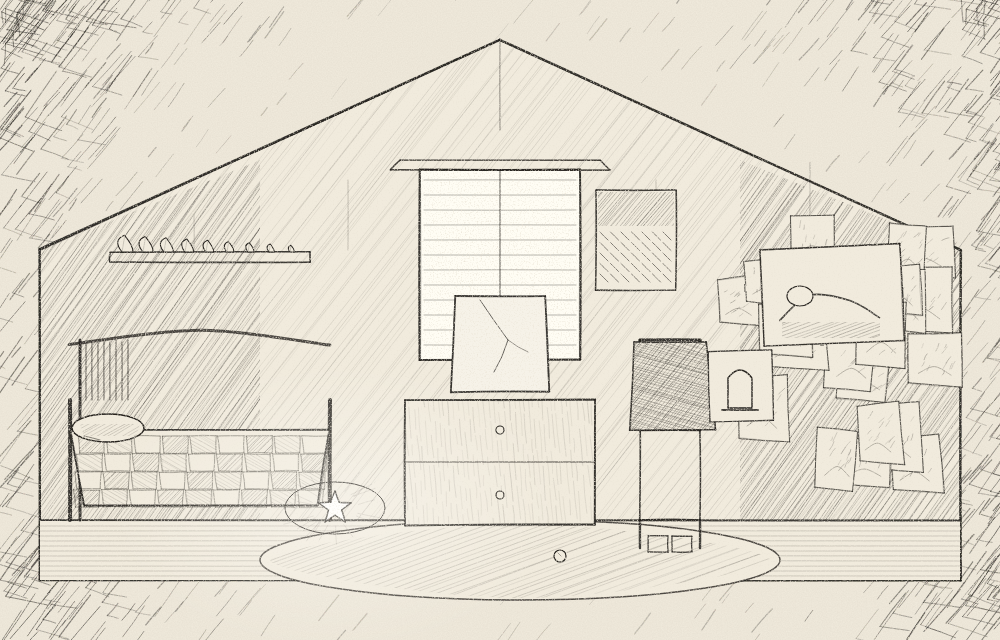
I do not mean that it was a bedroom like hers. I mean that it was hers. The narrow iron bed under the sloping ceiling, with its patchwork quilt, the one my mother had made from my father's old shirts. The shelf with the seashells on it, in a row, graded by size. The chest of drawers with a cracked mirror. The rag rug. The little chair with its back to the wall, and over its back, folded, a school jumper, grey, with a darn at the elbow.
She had had a night light. A little glass starfish that plugged into the wall and glowed a pale watery green. I saw it in the corner, in its socket, and I thought, no.
It was on.
It was glowing. A faint steady shimmer, the colour of weak mint, throwing a spreading stain across the skirting board. There had been no electricity in that house for four years. I had stood in the hall, in the dark, with the switches dead under my hand. And a child's night light burned in the corner of that room as though it had never been turned off.
I looked at it for a long time.
I did not touch it.
This is the part I find hardest to write, because it is the part I could not understand and cannot yet.
The room was impossible. I do not use the word loosely. I measured it afterward, in daylight, with a tape. My mother's house is a narrow terraced house with a frontage of fourteen feet. The party wall runs along the left of the bedroom, and the next house along, Mrs. Ashby's, begins on the other side of it. There is no space there. There never was. A door papered into that wall should have opened on brick.
It opened on a room twelve feet long.
It ran in under the roof, with its sloping ceiling, and it ended in a small dormer with a drawn blind, and I stood in the middle of it and understood that it lay, in terms of the street, inside Mrs. Ashby's kitchen. And that Mrs. Ashby's kitchen was a lit and ordinary room, I had seen it through the window as a boy, with a table and a clock and a canary.
I stood there, in a space that could not be, and felt the floor tilt.
And the room was not only hers.
That was the thing that broke me, in the end. I had expected, if I expected anything, a shrine. A preserved moment. Her things, as she had left them, with the dust on them. I had a picture of it ready: a child's room, shut for ten years, grey and still.
But the dust was not there.
The quilt had been turned back. There was a dent in the pillow. On the bedside table, beside a glass of water that was half full, there was an exercise book lying open face down, and a pencil sharpened to a long fine point, and a plate with the dried rind of an orange on it. The bed had been slept in. The room was lived in. It had the soft rumpled warmth of a place that someone had left a few hours ago and meant to come back to.
And there were things in it that I did not know.
A second chair, a wooden one, pulled up to the bed, with a man's cardigan over the back. Brown. Wool. I had never seen it. On the floor beside the chair stood a pair of men's shoes, size ten, neatly paired. A chessboard on a stool with the game half played, white to move. A shelf of books that had not been in the house: a battered atlas, a book of birds, a stack of detective novels with cracked spines. A calendar pinned to the wall by the window, a cheap one from a hardware shop, with a photograph of a lighthouse. It was open to a month and a year that were four years later than the date on which she had gone.
Every day on it was crossed off in pencil. Every single one, in neat diagonal strokes, up to the current Saturday.
I took a step toward the calendar and my foot came down on something that rolled. I looked. It was a small round object, and I picked it up. A marble. A blue glass one, with a white swirl in it, that I had owned when I was eleven and had lost behind a radiator.
I held it up to the starfish light, and the swirl turned, and for a second I was eleven years old, kneeling on a rug in a room with a sloping ceiling, and a girl with a crooked fringe was saying, give it back, Daniel, it's mine, you gave it to me.
I did, I thought. I did give it to her.
I had no memory of it at all.
The drawings were on the far wall.
I saw them last, because they were beyond the bed, in the dim end of the room where the ceiling came down, and the light of the starfish did not reach. I had to go round the bed, sideways, with my back brushing the quilt. I lifted the torch.
The whole wall was paper. A hundred sheets, two hundred, pinned edge to edge, overlapping, in pencil and in crayon and in a soft black charcoal that had smudged along the margins. Some were old, curling at the corners. Some looked as though they had been drawn a week ago. I stood in front of it, as one stands in front of a window, and I felt my lungs forget their business.
They were Anna's.
I knew her hand. The loops she put on her gs. The way she shaded with the side of her pencil, in long soft strokes, so that every shadow had a faint grain, like cloth. She had been good, even at nine, even at ten. She had been better than anyone I knew.
There were drawings of the house. The kitchen, from the doorway, with my mother's back at the sink. The garden in snow. There were drawings of the street, every house with its door and its chimney and its small dark window. A cat on a wall. A tram. A great many drawings of hands.
And there were drawings of me.
I do not know how many. Thirty. Forty. Some of them were quick, a few scratchy lines, a boy at a table with a book. Some were careful. I was shown eating, and reading, and laughing at something off the page. I was shown with my hair longer, and then short, and then longer again. I was shown at fifteen, and sixteen, and seventeen, and then, with a sensation like cold water poured down my back, at nineteen, and twenty.
A year at a time. A year at a time, in a room I had never known existed, a girl had sat on a bed and drawn her brother growing up.
In the centre of the wall, a little higher than the rest, was a drawing larger than the others. It was a sleeping man. He lay on his side with one arm flung out, in a narrow bed. The face was in shadow, but the shape of the jaw and the way the hair fell across the forehead were unmistakable. I looked at the pillow. At the shape of the window above it. At the pattern of the quilt.
It was my bed. In my flat on Tannery Row.
It was a drawing of me asleep. It was so exact that I could see the crease in the pillowcase. And in the bottom corner, in the neat upright childish hand, was the date.
It was Sunday's date. Yesterday's.
I was asleep, I thought. I was asleep, and she was in the room.
I had to stop and put my hand flat against the wall.
When I could look again, I looked a little to the right, and there was another drawing, and I did not understand it at first.
A city.
It was drawn from above, as though from a ledge, in dense black charcoal. Streets, hundreds of them, running in a spiral, in lanes and arcs and narrow courts. Little houses, windows, gables. Lamp-posts, tiny and precise. A tram line. A river, a pale coil of white paper, with a bridge. It was Veyra, very nearly. It had the shape of Veyra. But it had been drawn upside down, the roofs hanging beneath the streets like roots, and over it, instead of sky, there was a great dark ceiling, rough and arching, from which hung a thousand small pale shapes.
Clocks.
She had drawn them very carefully. Round, square, old pendulum clocks, station clocks with Roman numerals, cheap alarm clocks, pocket watches on chains. They hung from the black ceiling like fruit. And every one of them, I leaned closer, with the torch at arm's length, every single one had its hands in the same place.
Seventeen minutes past eleven.
I felt something move behind me. It was only the air. The blind, shifting. I did not turn.
There was one more drawing. It was pinned a little apart from the rest, in the lowest corner, where the sloping ceiling met the wall. It was small. It was drawn on a torn sheet of lined paper. I crouched down.
It was a grave.
A very simple one. A mound of earth with a headstone at the head of it, rounded at the top, and a few tufts of grass. It had been done in hard pencil, with a great deal of care. Someone had spent a long time on it. The lettering on the stone was so precise that it might have been cut by a mason.
DANIEL CARTER
And beneath it, smaller:
9 March —
And then a dash. And after the dash, nothing but a time.
11:17.
I stayed there on my heels for I do not know how long. I remember that the starfish light had begun to flicker. I remember the smell of oranges, and the sound of my own breath, which seemed to be coming from somewhere else. I remember a cold, slow, level thought: she would have been twenty-two.
I took out my telephone, because I did not know what else to do. It is what I do. A record is a thing one can hold. I held it up in front of the drawing and took a picture, and the little flash went off and lit the whole wall white for a second, so that every drawing leapt out at me at once, and every face I had worn looked down on me with a pencilled eye.
I lowered the phone, and looked at the screen.
It was the right picture. The same drawing, the same torn lined paper, the same mound of earth, the same stone, the same hard careful lettering. It was an exact copy.
Except for the name.
I held the telephone to the light, and I looked, and I looked, and then I looked up at the wall.
On the wall, the stone said DANIEL CARTER.
On the screen, in the very same hand, in the very same pencil, it said ANNA CARTER.
I looked at the wall. I looked at the screen. I turned the phone round and held it flat beside the drawing, as one holds a document beside its copy, and the two stones sat side by side in the green light, one name above one grave, and I could not make them agree.
Both were in her handwriting. Both were perfectly clear.
And somewhere behind me, in the hall, at the bottom of the stairs, the front door, which I had locked and which I had not unlocked, very quietly began to open.