Chapter Ten
The Last Person Who Remembered
"It isn't a creature," said Anna. "I want you to understand that before you decide."
We had stood up. She had put the glass marble into the pocket of her cardigan, and she held my hand in both of hers, and together we walked slowly down the long aisle between the benches, toward the door. The faces turned to follow us. Nobody spoke. The whole vast hall had gone so still that I could hear the small dry sound of my own shoes.
"It never was. They called it the Listener, upstairs, and I think they meant it kindly. But it isn't a thing that listens." She frowned, working it out. "It's a thing that's left. It's what's left over, when a person is loved, and then isn't. All of that longing, that wanting somebody back. It doesn't go anywhere. It can't. It has to be somewhere. And in Veyra, it's here."
"And the Department?"
"Keeps it quiet." She looked up at me. "They found a way. If nobody remembers, nobody longs. If nobody longs, it's hungry, and it's weak, and it doesn't call. They've been starving it for sixty years. And all that time they've been bringing it the things they take. The photographs. The names. They put them on the shelves. Because it can't bear to be empty."
"So they feed it."
"A little. Enough to keep it from breaking out." Her voice was very soft. "They think it's a kind of gaol. But it's more like a, a cellar, Dan. Where you keep a person you're ashamed of. For ever. With the lights out. And every year it's bigger, and quieter, and hungrier, and more polite."
I thought of the mild courteous whisper in the tunnel. Daniel. The voice of someone reading from a list.
"What happens if it breaks out?" I said.
"I don't know."
"What happens if it's let go?"
She stopped.
We had come to the foot of the great arch, where the light was brightest. Beyond it, the vast hall opened out into a circular space, a kind of rotunda, empty except for a single object in the centre. It was a plain stone plinth, waist high, with a lever on it. A great, black, iron lever, like the lever of a railway signal, set in a slot, with a worn brass handle.
I knew what it was. I do not know how.
"That," said Anna.
"What does it do?"
"It opens the shelves."
I looked at it. The light fell straight down on it from nowhere, and gleamed on the handle.
"All of it goes back," said Anna. She was whispering now. "Everything in here. Every name, and every photograph, every voice. Every person on every bench. It goes back where it came from. It goes into the heads of every person who ever knew them, all at once, in a rush, like water into a dry well." She swallowed. "Every mother who forgot a child. Every man who forgot his wife. All of them, remembering. At the same time. At night. In their beds."
I did not speak.
"It would be so loud," said Anna. "You've no idea. It would be the loudest thing that has ever happened. There'd be people who couldn't bear it. There'd be, I think, people who didn't live through it." Her eyes were very wide. "And it's the only way I know that anyone ever gets out."
"And the thing?"
"It would be remembered." She said it slowly, as if the words were a strange taste. "Properly. Fully. By everyone. It would stop being what's left. It would be... known. I think it might just stop. Or it might be everywhere." She shook her head. "Or it might be very, very glad."
"You don't know."
"No."
"And if I don't pull it?"
"Then I stay," said Anna simply. "And all the others stay. And you go home, and the city forgets you, a bit more every day. And it goes on very quietly, the same as before, for as long as the Department lasts. Which is a long time." She lifted her chin. "I'm not going to ask you to do it. I want you to know that. It isn't fair to ask. You've already done enough. You've done more than a person should."
"But you want me to."
She looked at me for a long moment.
"I want to go home," said Anna. "I'd be lying if I said I didn't. I want to see Mum." Her voice cracked. "But I don't want to be the reason that a lot of people can't sleep. And I don't want you to do it because I asked. I want you to do it, or not do it, because you think it's right."
"What do you think is right?"
"I think," she said, "that I've been here a very long time. And I'd like, for once, not to have to think."
A voice called my name.
It came from a long way off, from the far end of the hall, from the door. It was a courteous voice. It carried perfectly. I turned my head, and saw, in the distance, at the end of the vast aisle, a small grey figure standing on the threshold of the light.
"Daniel!"
David Miller had come to the very edge of the iron door. He could not enter. I saw that. He stood just beyond the sill, one hand on the frame, with the other lifted, as though he were holding back a wave. His silver hair shone. His face, even at that distance, was white.
"Daniel! Please! Don't touch the lever!"
I did not answer. I put my hand, almost without noticing, on the cold stone plinth.
"You don't know what you're doing!" His voice cracked. It had lost its gentleness. It was high, and fast, and very human. "I know what you've been told. I know what she's said. But she's not, she can't be, you don't know what she is. I have been to this door. I've stood on this sill every night for thirty years. I've heard what's in there. You cannot imagine what it would do to a city."
"I know," I said. It came out quietly. He could not have heard.
"Eight hundred thousand people! Ten thousand griefs apiece! There are men who have forgotten they killed someone! There are women who forgot they gave a child up! There are families that live together in peace because they do not remember what they did to each other!" He was shouting now. "You'd be giving them back every single thing! Do you understand? There is such a thing as mercy!"
"I know what mercy is," I said.
I turned.
I walked back down the long aisle, between the benches, slowly, and as I went the people on the benches raised their faces to me, and I did not look at them. I did not stop until I stood in front of him, at the edge of the iron door, six feet from the sill, with the cold grey light behind me and the whole warm lamplit vault in front.
James Wilson was sitting on the floor with his back against the wall. He had put his lantern down. He had the great black ledger open across his knees, and a pencil, and he was writing, very slowly, with his big scarred hands, in a column of small blue figures. He did not look up.
"Mr. Miller," I said.
"Daniel." He was panting. "Please."
"Tell me about Peter."
His face changed.
"I don't..."
"You forget him every spring. You've forgotten him eleven times. You keep a card in your wallet." I did not raise my voice. "You told me yourself. You said that every year you find it, and you read it, and you're very angry for about a month."
"That's, that's different..."
"What did you do," I said, "to your son?"
David Miller put his hand to his mouth.
I will not forget his face. It did something I have only seen a face do twice, and the second time was in the mirror. It did not collapse. It went on looking exactly as it had before, perfect and composed and grey. But behind it, very far back, I saw something slowly give way, the way a floor does when a beam has been rotten for years.
"He was nine," said David.
"Yes."
"He was nine, and he went down the stairs at night." The words came out like stones. "In the house. At a quarter past eleven. I heard it. I was in the study, I had a hand on the lamp, and I heard it. I heard him say, Dad?" His whole body shook. "It said, Peter, it's Dad. From the street. In my voice. And I sat there. And I did not go. I held on to the desk. I told myself, it's not true, it can't be. And it wasn't me. And he went out, and I heard the door."
"And you've been forgetting him since."
"I forget him so I don't call." It came out in a whisper. "That's all I've ever done, Daniel. That's all the Department is. A lot of frightened people who couldn't stand it, who found a way to stop calling." He lowered his hand. His eyes were running. "I'd give anything. I'd give anything to say his name aloud just once."
"Then do it."
"I can't." He shook his head. "It would hear."
"Yes," I said. "That's the idea."
I held out my hand.
I do not know what I meant by it. I only know that I stood in front of that old, weeping, courteous man in his pale grey suit, with my palm open, and that for a long, long moment, he looked at it, as one looks at something unaccountably precious.
He took it.
His fingers were icy. They closed on mine with a grip that hurt.
"Peter," said David Miller.
It was hardly a sound. It was a breath. He said it into the silence of that great place, and I felt it go out, like a ripple, over the benches and the shelves and the thousand faces turned toward us, and I felt, in the deep stone of the floor beneath us, something stir.
"Peter Miller," he said, louder, "my son."
James was still writing.
I had not realised. He sat against the wall, with the ledger across his knees, and a small expression of enormous concentration on his big heavy face, and the pencil moved steadily on. I stooped, and looked over his shoulder. It was a list of names.
"They're the ones from the Corrections," he said, without raising his head. "Forty-one pages. There's a thousand and six. I thought you'd want them in order." He turned the leaf. "I've put the dates. I've put the streets. I've put, where I knew it, who it was that loved them." He looked up at last, and his eyes were red-rimmed and bright. "You'll want to read them. Aloud. I rather think that's how it's done."
I took the ledger.
It was heavy. The paper was soft with age. I looked at the first page, the long careful columns, the spiky blue hand, and I saw, near the top, in small neat letters, CARTER, Anna M. And I saw, a little below, PRENTISS, Edith. 14 Mill Row. Mother of three. OUSELEY, Frank. Cooper. Dearly loved. PETTIFER, Hilda. I did not know the last. I read it again. Wife of Mr. Pettifer, umbrella-maker. I thought of a stout bald man in a doorway, saying Flat three's empty.
I went back up the aisle.
I do not remember my feet. I remember that the light grew, and the benches rose on either side of me, and the faces turned. I remember that I came to the rotunda, and the plinth, and the great black lever with its worn brass handle, and that Anna was standing beside it with her hands at her sides, quite still, looking at me.
"You've decided," she said.
"Yes."
"Are you sure?"
"No." I put the ledger on the plinth. I opened my notebook and laid it beside it, on top of the stone, and I took out my pencil. "But I've never been sure. I've spent twenty-six years looking things up. I thought that was the same."
She smiled.
It was a small, sad, enormous smile. The gap in her teeth was on the left.
"Whatever happens," said Anna. "Whatever it is. I'd like you to know I remember you."
"I know."
"Because I do." She stepped forward and put her arms round my waist and her cheek against my ribs. She was warm. She was very light. "I think that's the only thing I'm sure of."
I held her. And I put my other hand on the lever.
It was colder than ice. It sank under my palm. I felt the whole weight of the city in it, the weight of every name and every unspoken grief. I opened my mouth, and the first name came to me before I had made up my mind to say it, quite naturally, as one finishes a sentence somebody else has begun.
"Anna Marion Carter," I said.
My voice rang out in the vast silence, thin and clear. I drew breath.
"Born the sixth of June. Daughter of Helen and Thomas. Sister of Daniel." I heard it go. I felt it reach the far walls. "She is my sister. I remember her."
I pulled the lever.
I can tell you what I heard, but not what I saw.
It began as a sound. A low, soft, enormous sound, like the first breath of a great sleeper. It came up out of the floor. It was not loud, at first. It was the sound of a million drawers sliding open at once, of a thousand doors, of ten thousand sheets of paper rising together like a flock of birds. And then it was loud. It rose and it rose. It filled the hall to the roof and went on rising, a vast rushing shining roar, the roar of a river bursting a dam, of a whole city drawing in its breath.
Voices.
They came from the shelves. They came from the jars, from the urns, from the boxes, from every cranny of that great unlit place. They poured out, in a flood, a torrent, laughing, weeping, calling, whispering, singing, saying names, a hundred thousand names, in every voice that had ever said them. Edith. Frank. Hilda. Peter. Tom. Margaret. Joseph. They went past me like a wind. They went up, through the pale roof, through the earth, through the old brick and the iron and the clay, upward, toward the sleeping streets.
I was reading. I do not know when I began. I stood at the plinth with the ledger open before me and my own voice going out in the middle of that wind, name after name after name, steady and clear. I read the whole of the first page. I read the second. I read, Pettifer, Hilda. Wife of Mr. Pettifer. I read, Miller, Peter. Son. My voice was cracking. It did not stop.
The benches were empty.
I saw it only from the corner of my eye. The people on them had risen, one after another, in a long slow tide, and were walking away. They did not hurry. They walked quietly, through the flood of voices, toward the great iron door, a long grey procession of men and women and children, with their hats in their hands, going out into the lamplit tunnel and up toward the surface, like a congregation leaving after a long service. The girl with the violin case went by. She looked up at me, in passing. Her face was shining.
I remember where I was going, she said.
I do not know how long it lasted.
When I looked up, the hall was empty.
The shelves were bare. Every photograph, every umbrella, every violin was gone. The great, curved, bone-pale racks stood open and echoing, stretched into the distance, and there was nothing on them at all, not a speck of dust. The light had dimmed to a clear, plain, ordinary grey. It was very quiet.
I stood at the plinth with the ledger open in my hands.
Anna was not there.
I had felt her go. I had felt her arms loosen, in the roar, and her cheek lift from my ribs, and a small hand squeeze mine, once, very hard, and let go. I turned, and there was the open door, and the long lit tunnel beyond, and a small figure in a yellow cardigan walking quickly up it, between the others, with her head high.
She looked back.
I could see her face. It was a very long way off. She was smiling. She lifted her hand, and waved, once, the way one does at a station. And then the crowd closed round her, and she was gone.
The silence was complete.
I do not think that I have ever known true silence before. It was not the quiet of the night, or of a locked room. It was the absence of a thing that had been there so long I had mistaken it for the air. It was the silence at the end of a lifetime's whispering. There was no tick. There was no drip. There was no breath, or footstep, or distant voice.
The whispers had stopped.
I stood in the great empty hall and I listened to it. It was the loveliest thing I have ever heard.
It is over, I thought. It has gone.
I thought of James, against the wall, with his pencil. I thought of David Miller, with his son's name on his lips. I thought of a long grey street, and eight hundred thousand people, in their beds, with their windows open, weeping into their pillows, and of a cold dawn coming up over Veyra, on a city that remembered. I thought of Michael, with a paper bag of cardamom seeds, and the name coming back to him in the dark like a word on the tip of the tongue.
I thought, I did it. Whatever it was. I did it.
And then, very softly, just behind my left ear, someone whispered my name.
It was not loud. It was a breath. A small warm movement of air, with a shape in it, and the shape was Daniel. It was not accusing. It was not frightened. It was simply, tenderly, glad.
I turned round.
There was nobody there.
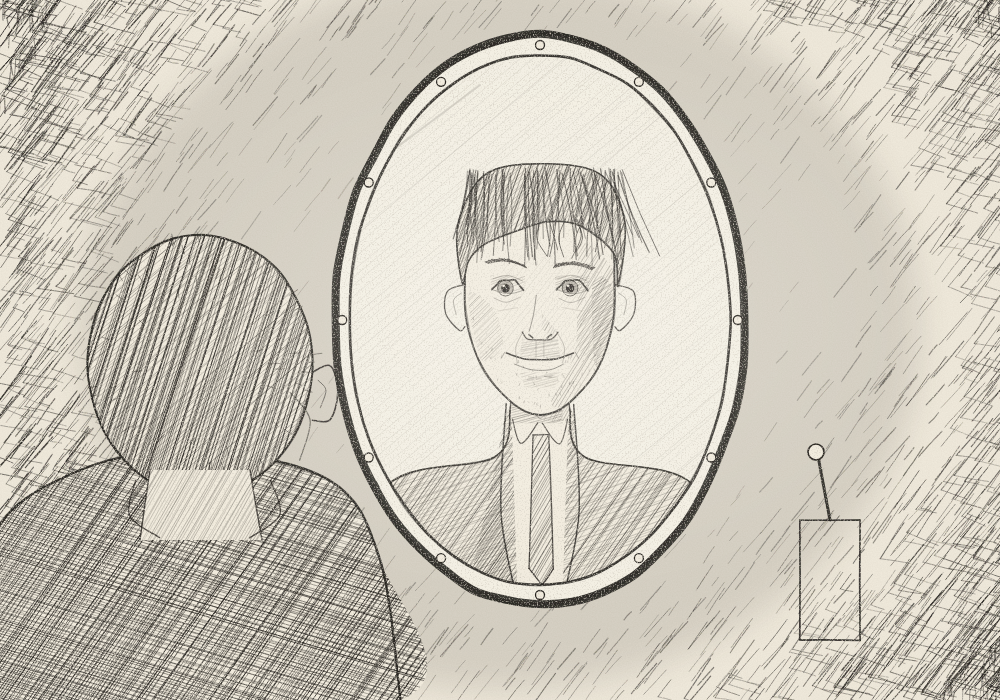
The hall was empty. The shelves were bare. The great iron door stood open on the tunnel, and the tunnel was empty, and there was nothing in the whole shining colourless space but the plinth, and the lever, and the ledger lying open on the stone, and, a little way off, at the end of the rotunda, in the curve of the wall, a tall oval mirror in a plain iron frame.
I had not seen it before.
I walked toward it. I do not know why. I walked slowly, over the cold floor, and I saw myself come toward myself: a thin young man in a ruined coat, with a drawn face and red eyes and a pencil stuck behind his ear. He looked tired. He looked, I thought, like someone who had done something large and was waiting to be told what it was.
I stopped in front of the glass.
He stopped.
I raised my hand, and he raised his. I tilted my head. He tilted his. I stood for a long moment in the silence, looking at the face of Daniel Carter, aged twenty-six, born on the ninth of March in Saint Aldous Hospital, in the city of Veyra, who trusted written records more than memory, who liked his tea black.
And the reflection smiled.
It was a slow smile. It began at the corner of the mouth, and spread, wide and warm and quite kind, the smile of a man who has been waiting a very long time at a window and has seen, at last, the person he was waiting for come up the path.
It was the smile in the photograph on the step of the house on Marrow Lane. Lopsided, and young, and happy.
I did not smile.