Chapter One
The Voice on the Dead Line
At nine minutes past eleven, I was reconciling a freight ledger and thinking about nothing.
I want that on the record. People tell these stories as though the person at the centre was waiting for something, as though the air in the room had gone strange. It had not. I was at the kitchen table in my flat on Tannery Row with a cold cup of tea, a ruler, and a pencil, checking that sixty-one crates of tinned fish had arrived at the depot in the same number in which they had left it. Below me, in the shop that mended umbrellas, the owner's radio had been switched off an hour ago. The street outside was quiet in the way Veyra is quiet after dark: not peaceful, only obedient.
If you are not from here, you will not understand how complete that quiet is. By ten, the trams run empty. By eleven, the last shutters are down. By the time the bell at Saint Aldous tolls the quarter, there is not a soul on any pavement in the city. There are no patrols. Nobody checks. The brass plates on the bridges simply stand there in the lamplight, saying what they say, and the whole of Veyra, eight hundred thousand people, goes indoors and shuts its eyes.
I had never once broken the rule. I did not know anyone who had.
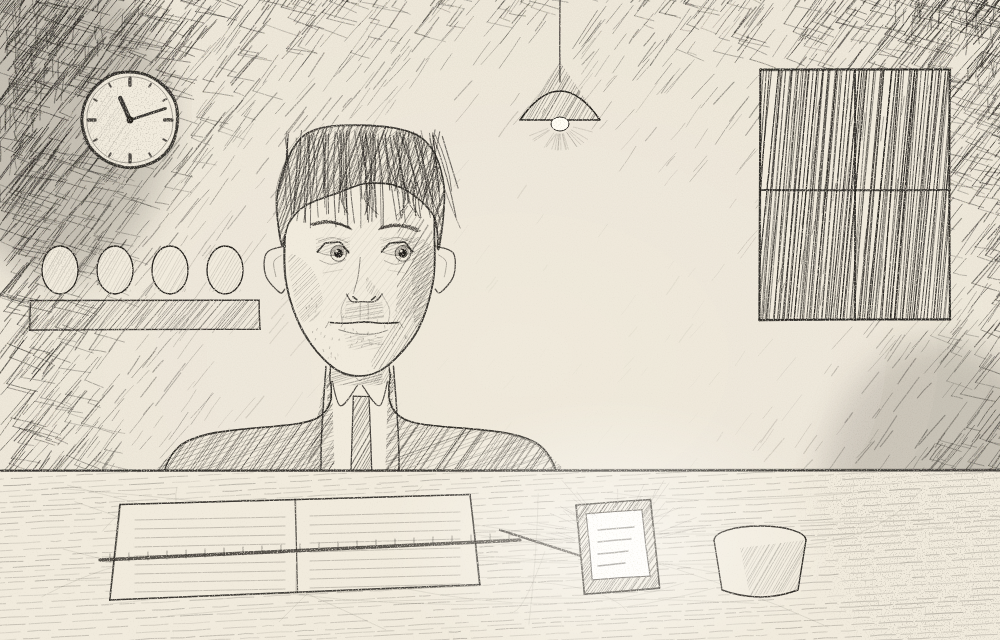
At eleven-twelve, my telephone rang.
It was a plain black handset, a cheap one, lying on the table beside the ledger, and it did not ring so much as shudder, a short grey buzz against the wood. I glanced at it, annoyed. Nobody called me after ten. My landlord, perhaps. The depot, about a damaged shipment.
Then I saw the name on the screen, and I stopped.
MARROW LN.
I had saved that number when I was nineteen. It was the telephone in the hall of my mother's house, a heavy cream thing with a curly cord that lived on a little table beneath the stairs. I had rung it every Sunday for seven years. I had let it ring, sometimes, for a long time, because my mother took a while to get to the hall, and I knew the sound of her slippers on the boards before she even picked up.
My mother had died four years ago in March. The house was shut. The telephone line, I knew this because I had signed the form, had been cut on the nineteenth of the following month. A man in a grey van had come with a little ladder and taken the connection off the pole.
The telephone buzzed against the table. MARROW LN. MARROW LN.
I did not pick it up at once. I would like to tell you I was frightened. I wasn't. What I felt, sitting there with my pencil in my hand, was something closer to embarrassment, the particular embarrassment of a man who has found an error in his own books. There is a mistake here, I thought. A number has been reassigned. Someone has the old line. That's all it is.
It rang eight times. On the ninth I answered.
For a moment, nothing.
I could hear the sound a telephone makes when it is connected to a great distance and nothing else: a slow hollow rushing, like wind in a long pipe. I said, "Hello?" My voice sounded thin in the little kitchen. "Who is this?"
The rushing went on. Then, beneath it, something shifted. A small sound, close to the receiver. A breath. The breath of someone who has been standing very near for a long time, trying to decide whether to speak.
"Daniel?"
I want to describe what that did to me, and I find that I can't, not in the way I would like. I have gone over it many times. The best I can say is that it was not a thought. It did not arrive in my head. It arrived in the muscles of my back, in the backs of my hands, in a part of me older than language, which heard a voice and simply knew.
It was a girl's voice. High, and a little hoarse, as if from a cold. It had a lilt on the second syllable, the way she always said my name, Dan-iel, as though it were two words and she was impatient with both. I had not heard it in ten years. I would have known it in a stadium.
"Anna," I said.
I do not remember deciding to say it. It was simply what my mouth did. And the instant it was out, I heard how it sounded in the kitchen, and I felt the old familiar weight settle on me, the thing I had carried since I was seventeen and had learned to carry without noticing. Because the thing about Anna is that, according to every document in the city of Veyra, she did not exist.
I should explain.
I had a sister. Her name was Anna Carter. She was four years younger than I was. She had short dark hair that she cut herself, badly, with the kitchen scissors, so that the fringe ran uphill. She had a scar through her left eyebrow from falling off a wall. She laughed with a gap in her teeth where a molar was coming in, and she wore a yellow cardigan with one button missing, and when she was twelve years old, she disappeared.
That is what I remember. And I remember it as I remember my own name.
But when I was seventeen, I went to the Registry of Births to get a copy of my certificate for a passport. The clerk, a pleasant woman, brought me the file. I looked at it. Under Mother's other children it said, in neat printed type: NONE.
I assumed it was an error. I asked her to check. She checked. She came back with the register for that year, and the register for the year after, and the register for the year before, and she turned each page carefully with a little licked finger, and there was no Anna Carter in any of them. She looked at me with an expression I had not seen on a face before. It was kind. It was careful. It was the expression one uses with a man who has said something that is not quite right.
I went home. I asked my mother. She was standing at the sink. She did not turn round. She said, "Daniel, you only ever had yourself."
There was something in her back when she said it. I have thought about that for ten years. A stiffness. As though someone had pressed a hand between her shoulder blades.
I did what any reasonable person would do. I decided that the record was correct, and that I was not. I put Anna in the drawer where we put imaginary friends and the names of the dead. I stopped saying her name. I became, over the years, a man who trusted what was written, because I had learned what happens to the other kind.
And now she was on the telephone.
"Anna?" I said again. My throat was tight. "Where are you? Where are you calling from?"
"Daniel."
"I'm here. I'm listening."
"It's so dark." She sounded very close. She sounded as though she were speaking into the hollow of my ear. "It's so dark here, and the clocks are wrong. Daniel. You were supposed to come back."
"I... Anna, listen to me. I'm going to..."
"Why did you leave me here?"
It was not an accusation. That was what I could not bear. If she had screamed it, I think I could have stood it. But she said it softly and with a sort of tired bewilderment, as a child asks something she has been waiting years to understand.
Why did you leave me here?
"I didn't," I said. "I didn't know. I didn't know where you..."
The line clicked.
It did not go dead in the ordinary way, with the long tone. There was only a click, small and exact, like a latch being closed, and then a silence so total that I took the handset from my ear and looked at it. The screen was dark. The little timer in the corner, which should have shown the length of the call, was blank.
I sat there. The tea had gone cold. The pencil lay across the ledger, where I had dropped it, drawing a thin grey line through the figure for crate sixty-one.
I opened the call log. And there, at the top, in plain white type: MARROW LN. 23:12. Answered. 00:41.
Forty-one seconds. I read it three times. Then I looked at the clock on the wall above the stove, and it said eleven-fifteen, and I understood, in the slow numb way that one understands such things, that there were two minutes left before the rule began.
I went.
I know how that sounds. I know what I told you, at the beginning, about the promise, and about the rule, and about myself. But I have thought about this for a long time, and I cannot find a version of that night in which I stay. I put on my coat. I took the torch from the drawer. I locked the door behind me, and I went down the stairs, past the umbrella shop with its blinds drawn, and out into Tannery Row at sixteen minutes past eleven, with one minute remaining on a clock that had governed my entire life.
The street was very still.
The lamps burned yellow in the damp air. A little rain had come and gone, and the cobbles shone, and the shop fronts stood on either side of me like a row of closed eyes. I could hear my own footsteps. Nothing else. No wind. No distant tram. Somewhere above, a window was open, and a curtain moved, and it was the only thing in the whole city that did.
Saint Aldous began to toll the quarter. The bell was low, and rounded, and slow, and I stopped under a lamp and stood quite still and listened to it, counting, though I knew the count by heart. One. Two. Three. It was an old bell. It had been cast in the year of the disaster, they said, and hung in the tower to mark the hour that the ironworks fell. I had always found it a little ridiculous, that such a bell should be asked to keep a city indoors.
Four.
Then it stopped, and the silence closed behind it like water.
It was eleven-seventeen.
I started to walk again. I did not run. Running seemed to me, in some obscure way, an admission. I turned at the corner of the tannery wall and went up the long hill toward Marrow Lane, past the closed bakery and the chemist's with its green cross dark and the tall blank face of the old cinema, and for the first eight minutes, nothing happened at all.
Then, somewhere behind me, a long way down the hill, someone said my name.
It was not loud. It carried perfectly. It came up the empty street in the clear damp air as though the whole city had been built to carry it, a woman's voice, low and warm and a little tired, with the lift of a question at the end.
"Daniel?"
I stopped.
The skin on my arms drew tight. My feet had stopped without my permission. I stood in the road with the torch in my hand, not turning round, looking straight ahead at the lamp at the top of the hill, and I knew that voice too. I had known it for twenty-six years. It had said my name on a thousand mornings, at the bottom of a staircase, over a sink, across a table.
It was my mother.
My mother was dead. I had stood at her bedside in Saint Aldous Hospital on the fourteenth of March, four years ago, and held her hand until it was cool.
"Daniel," she said again, nearer. "Daniel, love. It's cold. Come and walk me home."
I did not turn.
I want you to know that it was the hardest thing I have ever done. Harder than anything that came afterwards. Because I wanted to. Every part of me wanted to. She was there, I could hear her, in the empty street, a few dozen yards behind me, in the voice that had kept me alive. Come and walk me home.
If you hear someone you love calling your name from an empty street, do not answer.
I walked.
I walked up the hill with my eyes fixed on the lamp, and I did not look round, and I did not answer, and behind me, step for step, at exactly the same pace as mine, I heard slippers on the cobbles.
The house on Marrow Lane stood where it had always stood, at the end of the terrace, a narrow brick house with a green door and a bay window and a gate that had never closed properly. The garden had run to weed. The windows were dark. A tile had slipped from the roof, and lay shattered across the path.
I did not look behind me. I went up the path, and found the loose brick by the step, the third one from the left, and slid my fingers into the gap behind it. The key was where it had always been. It was cold and slightly damp. I fitted it to the lock, and the lock turned with a clean, oiled sound, which I noticed, and put away.
I stepped inside and shut the door and turned the key.
The slippers stopped.
I stood with my back against the wood, in the hall, in the dark, and my heart was going so hard that I could feel it in my teeth. I waited for a knock. For a voice. There was no sound at all, from the house or the street. I put my ear against the door. I could hear nothing but my own pulse.
Slowly, I turned on the torch.
The hall looked as I had left it. The coats were gone from their hooks. The mirror on the wall was draped with a sheet. The floorboards were thick with grey dust, and the staircase went up into the dark on my left, and under it, on its small table, sat the telephone.
It was the cream one. The heavy one. The curly cord lay across the table in loose coils, and where it should have joined the wall, it ended. I went closer. It had been cut. Neatly, with a blade, a clean slanting cut, and the two copper ends, grey with age, lay on the wood a hand's width apart.
The receiver was off the hook.
It lay on the table beside its cradle, face up, and I stood and looked at it. It was too clean. The table was furred with dust, a quarter-inch of it, soft as felt. The receiver had none. It lay in a bright oval where the dust had been rubbed away.
I put out my hand, and touched it.
It was warm.
I do not mean that it was at room temperature. I mean that it was warm in the way that a thing is warm when someone has been holding it. Warm like a cup. Warm like a hand. I snatched my fingers back, and the torch beam jerked across the wall, and for a moment the whole hall lurched, and then steadied.
I should have gone. I knew it. A reasonable man would have gone back out through the front door and down the hill, whatever was waiting there, and into his flat and under his blankets. But I had turned the key, and I had come to find something, and my legs, I think, were not entirely mine.
I turned to go up the stairs. I turned, in the dark, with the beam sweeping across the hall, and it passed over the inside of the front door.
I stopped.
The beam came back.
There was writing on the door.
It was on the pale painted wood, at about the height of my chest, in pencil. Soft grey pencil, thick and dark, as though it had been pressed with great care. The letters were upright and a little crooked. Capitals. Each one carefully formed, in the way that a child forms letters when she is trying very hard.
YOU REMEMBERED HER.
I read it. I read it a second time. The torch trembled in my hand, and the light jumped with it, and the letters seemed to shiver on the wood.
I knew the writing. Of course I did. I had known it for ten years. It was on the backs of old photographs I no longer owned, on a birthday card in a box I had burned. It was the handwriting of a girl who had not existed.
But there was something else about it, and it took me a long moment to find. I put out the torch and then switched it on again, to be certain.
The writing had not been there when I came in.
I had stood with my back against that door. I had pressed my ear to it. I would have felt the grooves.
It has just been written, I thought. While I was looking at the telephone.
And then, as I stood there, quite still, with my breath in my throat, I saw the graphite. It was bright. It had the fresh dark sheen that pencil has only for a few minutes after it is drawn, before the air takes the shine away. And at the bottom of the last letter, in the final curve of the R, a very small flake of lead had broken off and lay on the paint like a grain of black salt.
Something in the house shifted. Above me, on the landing, a floorboard took a weight and gave it back.
I did not look up.
I looked at the door, because I could not make myself do anything else. And I watched, in the narrow cone of the torch, with a perfectly clear and ordinary attention, as beneath the first line, in the same upright childish hand, a second one began to appear.
It did not appear all at once. It came letter by letter, quite slowly, each one forming with a small dry scratch, the sound a pencil makes on wood. There was nobody there. There was nothing there. There was only the door, and the light, and the sound of the lead drawing itself across the paint.
NOW IT REMEMBERS YOU.
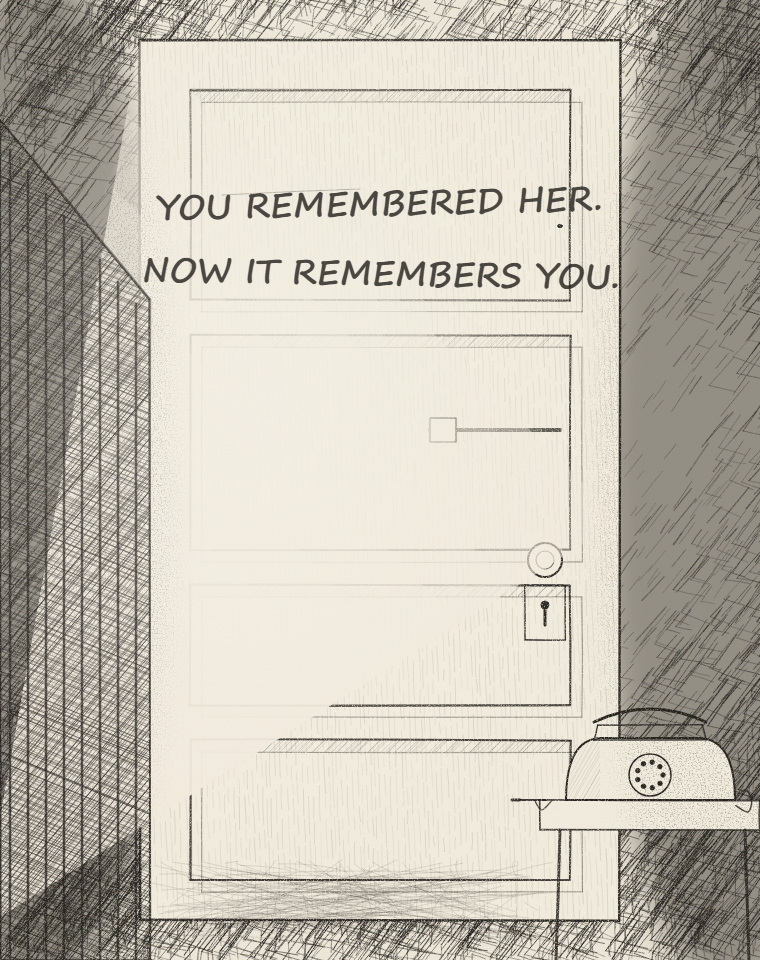
The scratching stopped.
The silence in the house was very large. And in the middle of it, behind me, in the hall, on its little table, under the stairs, the cream telephone with the severed cord began to ring.